The Meenakshi Amman Temple stands by the southern bank of the Vaigai River as the historic heart of Madurai. Known formally as the Meenakshi Sundareswarar Temple, this sprawling complex is dedicated to the goddess Meenakshi, a form of Parvati, and her consort Sundareswarar, a form of Shiva. If you are travelling across Tamil Nadu from Pondicherry, an excursion inland to Madurai offers an encounter with ancient architectural traditions and unbroken daily devotions that stretch back well over a thousand years.
Madurai is an easy city to navigate once you orient yourself around the temple towers. Thousands of devotees and travellers walk through its gates every day, making the complex both a quiet spiritual sanctuary and the central economic pulse of the town. Taking your time to wander through its stone corridors will help you appreciate the intricate layers of history, craft, and faith preserved within its high masonry walls.
At a glance
| Best time of day | Early morning or late evening for cooler stone floors and peaceful darshan |
|---|---|
| Allow | 3 to 4 hours to explore the shrines, hall of columns, and temple tank |
| Dress | Strictly modest clothing covering shoulders and knees; traditional attire preferred |
| Photography | Restricted inside inner corridors and sanctums; rules vary and are posted at gates |
| From Pondicherry | roughly 330 kilometres, about 6 to 7 hours by road |
Why This Sacred Ground Matters
Madurai was praised as a temple city in ancient Sangam literature, and early Tamil texts mention a temple here as far back as the 6th century. The temple is celebrated as one of the Paadal Petra Sthalams, places sung in the Tevaram hymns by the Shaivite Nayanar poets between the 6th and 11th centuries. Early stone structures arose under the Pandya dynasty during the 12th and 13th centuries. Following damage caused during the 14th century, the complex was rebuilt under the Vijayanagara Empire and later expanded into its present grand layout by the Madurai Nayaks during the 16th and 17th centuries.
The theological framework here is rare because it holds Shaivism, Shaktism, and Vaishnavism in mutual harmony. Shiva is Sundareswarar, the groom; Vishnu plays the role of Meenakshi’s brother who gives her away in marriage; and Meenakshi herself stands at the spiritual center of the temple. The name Meenakshi translates from Tamil as fish-eyed, from mina and akshi, an epithet of serene beauty. Local tradition holds that she was born in Madurai to King Malayadhwaja Pandya and Queen Kanchanamalai. Because she is regarded as the mother and protector of the city, devotees approach her shrine first before paying respects at the shrine of Sundareswarar.
Sundareswarar’s presence also marks one of the Pancha Sabhai, the five historic halls where Shiva is believed to have performed his cosmic dance. Here, that court is known as Velli Ambalam, or the silver stage, marked by a sculpture of Nataraja resting upon a broad silver altar.
What You Will See Across the Complex
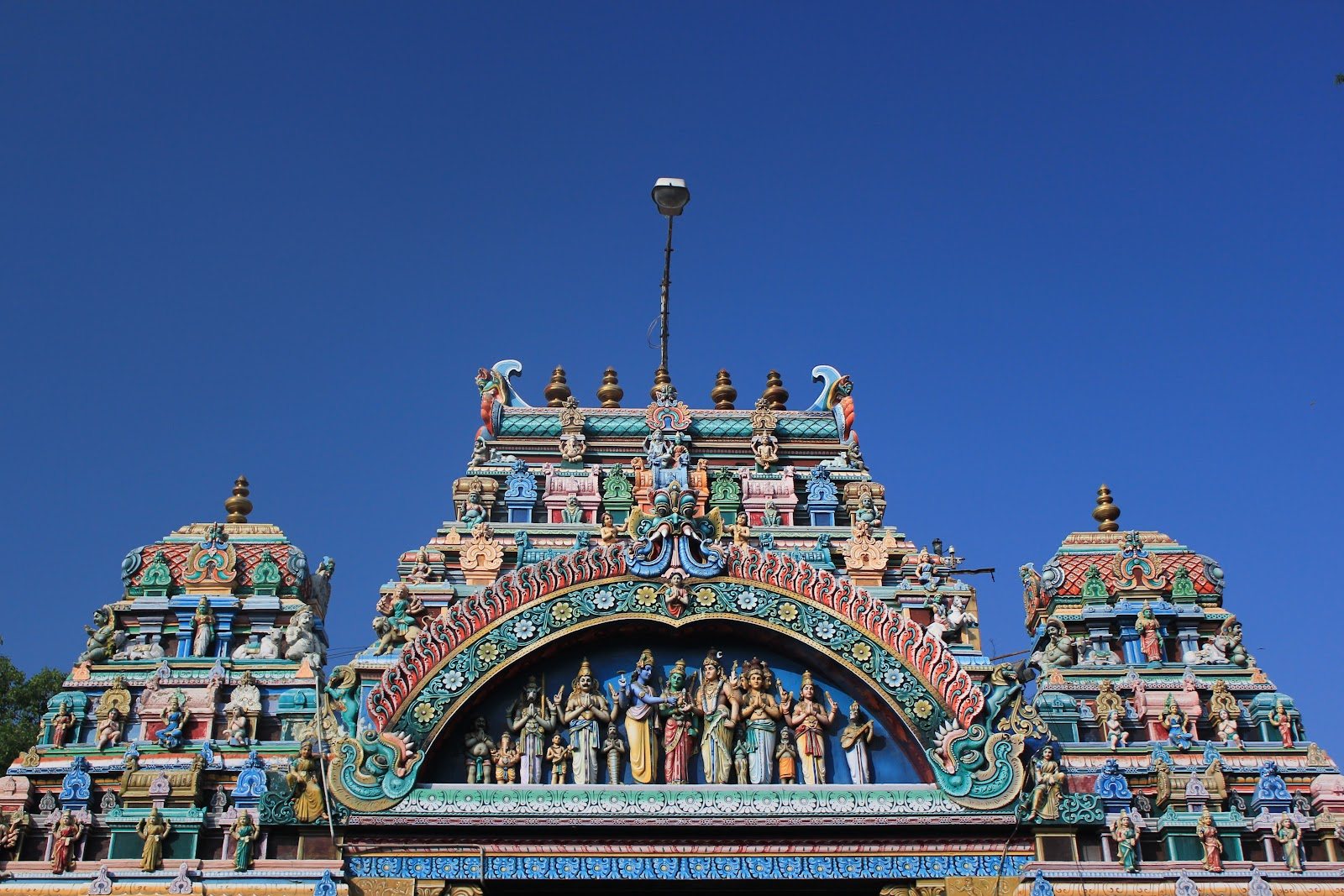
The entire temple enclosure spans 5.7 hectares, or roughly 14 acres, framed by layered stone corridors called prakaras and protective outer ramparts. As you approach from the surrounding streets, fourteen gopurams or ornate gateway towers dominate the skyline. Four monumental towers stand at the cardinal directions, accompanied by ten smaller towers inside. The south gopuram, built in the 16th century, rises highest at roughly 170 feet (52 metres). The west gopuram is equally famous, serving as the artistic model for the official state emblem of Tamil Nadu.
| Architectural Feature | Historical Period | Notable Detail |
|---|---|---|
| Southern Gopuram | 16th Century | Tallest gateway tower, standing at 170 feet (52 metres) |
| West Gopuram | 16th-17th Century | Inspiration for the official emblem of Tamil Nadu state |
| Thousand Pillared Hall | Nayaka Period | Monumental hall containing sculpted stone pillars and deities |
| Potramarai Kulam | Nayaka Period | Golden Lotus Pond enclosed by pillared porticos |
Within the walls, you will walk past numerous assembly mandapas. The most celebrated is the thousand pillared hall, renowned for its disciplined rows of carved stone figures that depict a wide array of deities and mythical scenes. Near the center lies the potramarai kulam, or the Golden Lotus Pond. This ancient stepped reservoir is surrounded by pillared walkways where pilgrims pause to rest. The entire complex is kept in clean condition, having received national recognition in 2017 as the cleanest iconic heritage place in India.
How a Visit Works
You will usually enter through one of the four main perimeter towers. Outside each entrance, you will find managed counters where you must leave your footwear before stepping past the threshold. Security checks are carried out at every gate, supervised under the Hindu Religious and Charitable Endowments Department of Tamil Nadu.
- Deposit your footwear at the designated counter outside your chosen gateway tower.
- Pass through the security check and step into the outer pillared corridors.
- Following customary tradition, proceed first toward the inner courtyard shrine of goddess Meenakshi.
- Continue through the covered hallways to the adjacent shrine dedicated to Lord Sundareswarar.
- Spend time walking the perimeter of the Potramarai Kulam and inspecting the sculptures in the thousand pillared hall.
Local tip: Note down which tower you entered through (North, South, East, or West). The concentric corridors look similar once inside, and remembering your gate saves confusion when retrieving your shoes.
Etiquette and What to Wear
Because this is an active place of daily worship, conservative clothing is mandatory for all visitors. Men are expected to wear traditional dhotis, pyjamas, or modest trousers paired with a shirt. Women should wear sarees, salwar suits, or long skirts and tops that cover the shoulders, chest, and knees. Shorts, sleeveless tops, and tight athletic wear are not permitted past the security gates.
- Leave all leather goods such as belts or large bags outside if requested by security staff.
- Keep your voice low and yield walkway space to priests and devotees carrying offerings.
- Follow all local notices regarding inner sanctums; while non-Hindus can walk through the prakaras, halls, and pond courtyards, access to the primary inner sanctums is reserved for Hindu worshippers.
- Photography policies change periodically; mobile phones and cameras may need to be deposited at security cloakrooms near the entrances.
Best Time to Go and How Long to Stay
The temple opens early in the morning, closes for a few hours in the middle of the day, and reopens from late afternoon until late evening. Visiting between 6:00 AM and 8:30 AM offers cooler temperatures and smaller crowds, allowing you to walk comfortably across the stone paving. The evening hours from 5:30 PM onward present another wonderful opportunity to observe traditional oil lamps being lit across the pillared halls.
Plan to spend between 3 and 4 hours inside the complex. This gives you enough time to move through the queues at both primary shrines, sit quietly along the portico of the sacred pond, and inspect the stone carvings of the thousand pillared hall without feeling rushed.
Getting There from Pondicherry and Where to Stay
Madurai lies roughly 330 kilometres southwest of Pondicherry. By private taxi or car, the drive takes about 6 to 7 hours travelling inland via Villupuram, Tiruchirappalli, and Melur along National Highway 38. There are also regular state express buses departing from the central bus stand in Pondicherry, as well as train connections that run through Viluppuram Junction.
When choosing accommodation in Madurai, staying within a short walking distance or auto-rickshaw ride of the temple towers allows you to attend early morning or late evening darshan with ease. Several dependable heritage hotels and comfortable family guesthouses are situated around Madurai Main and West Perumal Maistry Street.
Nice to Combine With
A visit to the temple pairs naturally with an exploration of Madurai’s culinary heritage. The streets surrounding the four towers are lined with traditional messes serving vegetarian meals on plantain leaves, as well as stalls preparing Madurai’s signature cold beverage, jigarthanda, made with milk, almond gum, and sarsaparilla syrup. If you enjoy South Indian filter coffee, small traditional coffee houses around Town Hall Road offer freshly brewed cups throughout the day.
For another glimpse into Nayaka architectural heritage, you can visit the Thirumalai Nayakkar Mahal, located roughly 2 kilometres southeast of the temple, which showcases dramatic arched masonry built during the same historical era.
What recent visitors say
A quick, honest snapshot from recent Google reviews, so you know what to expect before you go.
What people loved
★★★★★ Anurag · in the last week
“✨ An Experience Beyond Words | Meenakshi Amman Temple, Madurai 🛕 Some places are not just meant to be visited; they are meant to be felt. ❤️ Standing before the magnificent Meenakshi Amman Temple, surrounded by its breathtaking gopurams…”
★★★★★ norman · a month ago
“Wanted to visit this historical temple and this is my suggestion for those who are planning to visit here: 1. Mobiles, smartwatches and footware aren’t allowed inside there are lockers near the gates (I’m sure about the West gate as I…”
★★★★★ Sonakshi · 2 months ago
“The famous Meenakshi Amman Temple is one of the most beautiful temples in India. This is also known as the Meenakshi Sundareswarar Temple, It’s located in Madurai and is dedicated to Goddess Meenakshi. The Meenakshi Amman Temple is a…”
Reviews via Google Maps. Opinions are those of their authors.
Frequently asked questions
Can non-Hindu travellers enter the Meenakshi Amman Temple?
Yes, visitors of all backgrounds are welcome to enter the outer grounds, the thousand pillared hall, and walk along the sacred pond porticos. However, entry into the innermost sanctums of Meenakshi and Sundareswarar is reserved exclusively for Hindu worshippers.
Are cameras and mobile phones allowed inside?
Regulations on mobile phones and cameras are strictly enforced and can change without notice. In recent years, electronic devices and cameras have been barred inside the inner corridors, and lockers are provided at the gateway entrances to store your items.
Why is the temple historically significant to Tamil Nadu?
Beyond its 6th-century poetic origins in the Tevaram and Sangam literature, the temple represents an extraordinary preservation of Pandya, Vijayanagara, and Nayaka craftsmanship. Its western tower is so revered that it forms the centerpiece of the official emblem of Tamil Nadu state.
What is the customary order of worship inside the temple?
Following centuries of tradition, devotees first visit the shrine of goddess Meenakshi in the inner courtyard. Only after offering prayers to the goddess do worshippers proceed to the adjacent shrine of Lord Sundareswarar.
Find it
Address: Madurai Main, Madurai, Tamil Nadu 625001, India