Annamalaiyar Temple stands at the foot of Arunachala hill in Tiruvannamalai, drawing worshippers and travellers from across South India and beyond. Dedicated to Shiva as Annamalaiyar and Parvati as Unnamulai ammai, the complex is one of the most venerated places of worship in the Tamil Shaivite tradition. It represents the natural element of fire, or Agni, making it an essential part of the five regional sanctuaries known as the Pancha Bhuta Sthalams.
A journey here from Pondicherry takes you inland through rural Tamil Nadu toward the commanding outline of the sacred hill. Long before you reach the town itself, the enormous stone gateway towers appear on the horizon, setting the tone for a visit grounded in centuries of continuous prayer and community life.
At a glance
| Best time of day | Early morning or late afternoon |
|---|---|
| Allow | 2 to 3 hours for the temple complex |
| Dress | Modest clothing covering shoulders and knees; traditional attire preferred |
| Photography | Permitted in outer courtyards; strictly prohibited inside inner sanctums |
| From Pondicherry | roughly 105 km, about 2.5 to 3 hours by road |
Why this temple matters
Annamalaiyar Temple holds a central place in the religious geography of South India. Categorised as one of the 276 Paadal Petra Sthalams, it was glorified by medieval Tamil Shaivite poets. The 7th-century Tevaram hymns composed by the Nayanars praise the site, and traditional accounts by Sekkilhar in the Periya Puranam record that Appar and Sambandar worshipped here. The temple is also celebrated in the 9th-century Tiruvempavai by Manikkavacakar and the 14th-century Tiruppukal composed by Arunagirinathar.
The names of the hill and temple explain their spiritual meaning. In Tamil, Anna means great or powerful, and malai means hill. In Sanskrit, Aruna refers to the rays of the sun, while achala means unmoving. According to the Shiva Purana, Brahma and Vishnu once debated which of them held supremacy. To resolve the matter, Shiva appeared as a vast column of fire and light known as a jyotirlinga, extending across the universe. Vishnu assumed the form of a boar and dug downward to reach its base, while Brahma took the shape of a swan and flew upward to find its crest.
Vishnu conceded that he could not locate the origin, admitting the limits of his quest. Brahma, however, encountered a descending thalampu flower and persuaded it to support a false claim that he had reached the top. Angered by this deceit, Shiva decreed that Brahma would not receive worship, while praising Vishnu for his honesty. Shiva manifested as the hill of Arunachala and subsequently took the form of the Agni Lingam at its base.
Another narrative relates that Parvati once playfully covered the eyes of Shiva, momentarily plunging the world into darkness. To atone, she came to Tiruvannamalai to perform penance at the hermitage of sage Gautama. After slaying the demon Mahisasura in the form of Durga, she was re-accepted by Shiva on the full moon day of the month of Karthigai. Historic stone records on the site show that the Chola dynasty established the masonry core in the 9th century CE, following earlier Pallava rule. The Hoysalas made this area their capital in 1328 CE, and rulers of the Vijayanagara Empire carried out extensive building projects between the 14th and 16th centuries.
What you will see across the grounds
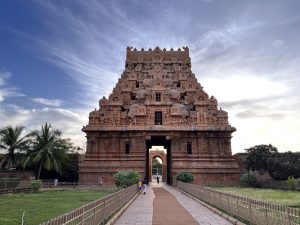
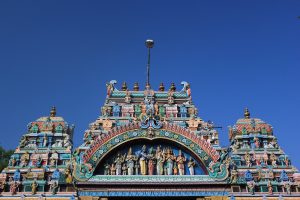
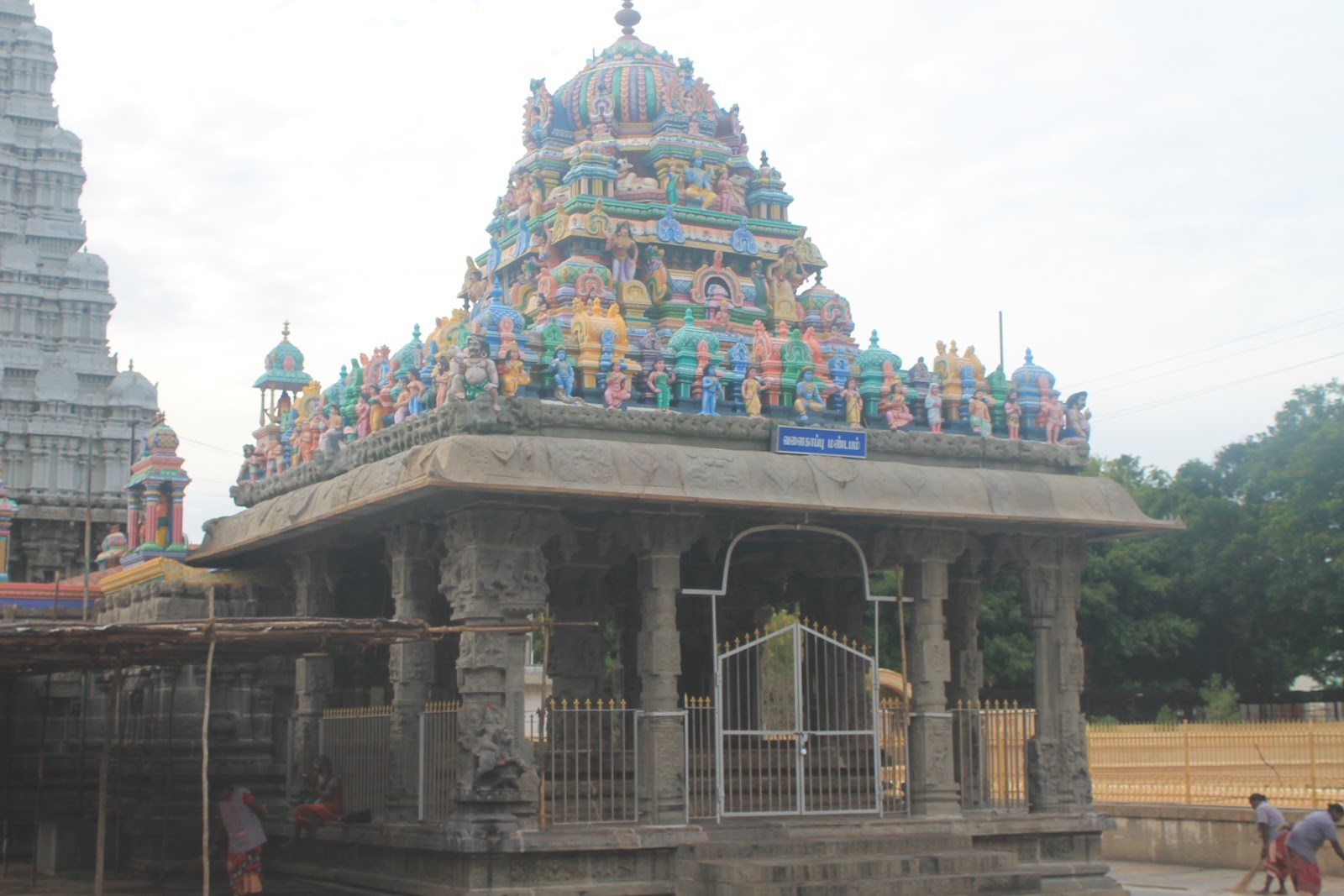
Covering roughly 10 hectares, this is one of the largest temple complexes in India. The grounds are bounded by tall perimeter walls punctuated by four massive gateway towers known as gopurams. The eastern tower, or Rajagopuram, is the grandest of all. Construction began under the Vijayanagara ruler Krishnadevaraya and reached completion in 1572 during the reign of Sevappa Nayaka. It stands 66 metres high, rising through 11 distinct tiers carved with figures from Shaivite tradition.
Stepping through the stone entrance, you arrive in the outer enclosures. The spacious thousand-pillared hall, erected during the rule of Krishnadevaraya, displays carved granite columns showing courtly patrons, guardians, and divine forms. Nearby sits a large temple water tank built during the same historical period. The open courtyards offer clear views of the red slopes of Arunachala hill rising behind the granite roofs.
As you move inward toward the core, the corridors narrow and the light dims. The main sanctum enshrines the Agni Lingam, representing Shiva as the cosmic fire. A separate major shrine houses Parvati as Unnamulai ammai, where she is revered through the Agni Yoni. Numerous smaller shrines dedicated to different deities are distributed throughout the enclosures, linked by covered walkways and massive stone thresholds smoothed by millions of bare feet over centuries.
How a visit works in practice
The complex is administered by the Hindu Religious and Charitable Endowments Department of the Government of Tamil Nadu. Daily temple rituals begin early in the morning at 5:30 a.m. and continue through six major worship services until the final ceremonies conclude around 10:00 p.m. During these times, temple priests perform ablutions, decorate the lingam, wave camphor lamps, and present traditional food offerings, accompanied by the rhythm of drums and the sound of bronze bells.
When you enter, you will find general entry queues as well as special paid queues managed by the temple office. The special lines require a small fee purchased at marked counters near the entrance, which can save considerable waiting time on festival days and weekends. Once inside the central corridors, visitors walk in single file past the sanctums. You will see local families, wandering sadhus, and pilgrims seated on the polished flagstones chanting devotional verses or resting quietly between prayers.
Local tip: Choose the special entry ticket queue if the temple is crowded. It moves significantly faster and leaves you with plenty of energy to explore the outer halls and courtyards.
Etiquette and what to wear
Because Annamalaiyar Temple is an ancient living sanctuary of deep religious importance, visitors are expected to dress modestly and observe traditional customs across all enclosures. Approaching the sanctums with quiet reverence ensures a respectful experience for the thousands of worshippers present each day. You will need to take off your footwear before passing through the outer gateway, leaving your shoes at the designated storage stalls near the entrance.
- Wear respectful clothing covering your shoulders and legs. For men, dhotis or plain trousers with shirts are standard. For women, sarees, salwar kameez, or long skirts covering the ankles are appropriate.
- Store your footwear at the official shoe stands outside the Rajagopuram, paying the small custodial fee upon collection.
- Keep mobile phones switched to silent mode and avoid loud talking inside the inner stone corridors.
- Photography is strictly prohibited inside the main shrines and inner courtyards. You may photograph the outer towers and architecture where permitted, but always check local signs.
- Non-Hindu visitors are welcome to explore the outer corridors and historic halls, though entry into the innermost sanctums can be restricted during specific rituals.
Best time to go and how long to stay
Plan your entry during the cooler hours of the day. The temple doors open around 5:30 in the morning, making dawn a peaceful time to walk through the stone enclosures before the sun warms the open courtyards. Midday can become quite hot, and walking barefoot across the granite paving stones between 11:00 and 15:00 can be challenging. An afternoon visit starting around 16:30 allows you to experience the evening ceremonies in comfortable temperatures.
Allow at least two to three hours for the temple grounds alone. This provides enough time to stand in the darshan queue, walk around the thousand-pillared hall, and observe the scale of the outer walls without feeling rushed. If you arrive on a weekend or an auspicious day of the lunar calendar, add an extra hour or two to account for longer lines.
The temple calendar features twelve yearly festivals. The largest of these is Karthigai Deepam, celebrated on the full moon day of the Tamil month of Karthigai. A colossal copper cauldron filled with ghee is lit as a beacon on the peak of Arunachala hill. The flame burns brightly across the countryside, representing the cosmic pillar of fire. Millions of pilgrims gather for the occasion, many performing girivalam by walking the 14-kilometre road encircling the mountain.
Getting there from Pondicherry and where to stay
Tiruvannamalai lies roughly 105 km west of Pondicherry. The road trip usually takes about 2.5 to 3 hours by private car or taxi, travelling via Villupuram or Gingee. Hiring an air-conditioned car for the day is convenient, giving you the flexibility to leave early in the morning, rest during the hot midday hours, and return to the coast by nightfall.
Regular state buses run between the Pondicherry main bus stand and the Tiruvannamalai central bus terminus throughout the day. While public buses take slightly longer than a private vehicle, they are dependable and very affordable. If you prefer to stay overnight in Tiruvannamalai, modest guesthouses and hotels line Chengam Road and the immediate perimeter streets surrounding the hill.
| Travel Mode | Approximate Travel Time | Notes |
|---|---|---|
| Private Taxi | About 2.5 to 3 hours | Most flexible choice; allows dawn departure from Pondicherry |
| State Bus | About 3.5 to 4 hours | Economical; departures run throughout the day from the main bus stand |
Nice to combine with
When driving between Pondicherry and Tiruvannamalai, the route passes near the historic hill fortifications of Gingee. Breaking your journey at Gingee Fort allows you to climb among medieval granaries, watchtowers, and moats set into dramatic granite ridges. It is best visited in the early morning before the heat picks up, leaving the afternoon for your temple visit in Tiruvannamalai.
In Tiruvannamalai, you can join pilgrims along parts of the Girivalam path around Arunachala hill, stopping at roadside eateries for freshly brewed South Indian filter coffee, crisp dosas, or warm idlis. If you appreciate historic religious architecture, you can contrast the massive scale of Annamalaiyar Temple with the quieter coastal atmosphere of Sri Vedapureeswarar Temple when you return to Pondicherry.
What recent visitors say
A quick, honest snapshot from recent Google reviews, so you know what to expect before you go.
What people loved
★★★★★ VR · 3 months ago
“I went on Girivalam on Poornima day which came on a Monday..I reached Rajagopuram for entering the temple and already heavy crowd built up on line at 4 pm..when I checked securities there they advised me minimum 3 to 4 hours to have…”
★★★★★ Kavitha · 3 months ago
“Divine place 2 June 2026. Some journeys heal the soul. ❤️🕉️ I had the opportunity to visit Thiruvannamalai on a weekday. The moment I arrived, I felt an indescribable sense of peace. My mind became calm, and my heart felt lighter. We…”
★★★★★ Kiran · 6 months ago
“My visit to Arunachaleswarar Temple and the sacred Girivalam (Giri Pradakshina) was one of the most peaceful and soul-refreshing experiences I’ve had. The temple is majestic, with stunning architecture, powerful spiritual energy, and an…”
Reviews via Google Maps. Opinions are those of their authors.
Frequently asked questions
What element does Annamalaiyar Temple represent?
Annamalaiyar Temple represents the element of fire, or Agni, within the five sacred Pancha Bhuta Sthalams. Shiva is worshipped here in the form of the Agni Lingam, reflecting the ancient column of cosmic light.
How high is the tallest gateway tower at the temple?
The eastern Rajagopuram stands 66 metres tall, or about 217 feet, rising across 11 tiers. Its construction began under the Vijayanagara ruler Krishnadevaraya and was finished in 1572 CE.
Can you visit Annamalaiyar Temple on a day trip from Pondicherry?
Yes, the temple is roughly 105 km from Pondicherry and takes about 2.5 to 3 hours each way by road. Leaving early in the morning lets you complete the visit and return comfortably by evening.
What is the Karthigai Deepam festival?
Karthigai Deepam is the major annual celebration held on the full moon day of the Tamil month of Karthigai. A giant flame is lit at the top of Arunachala hill, attracting millions of pilgrims who walk the circuit around the mountain.
Find it
Address: Pavazhakundur, Tiruvannamalai, Tamil Nadu 606601, India