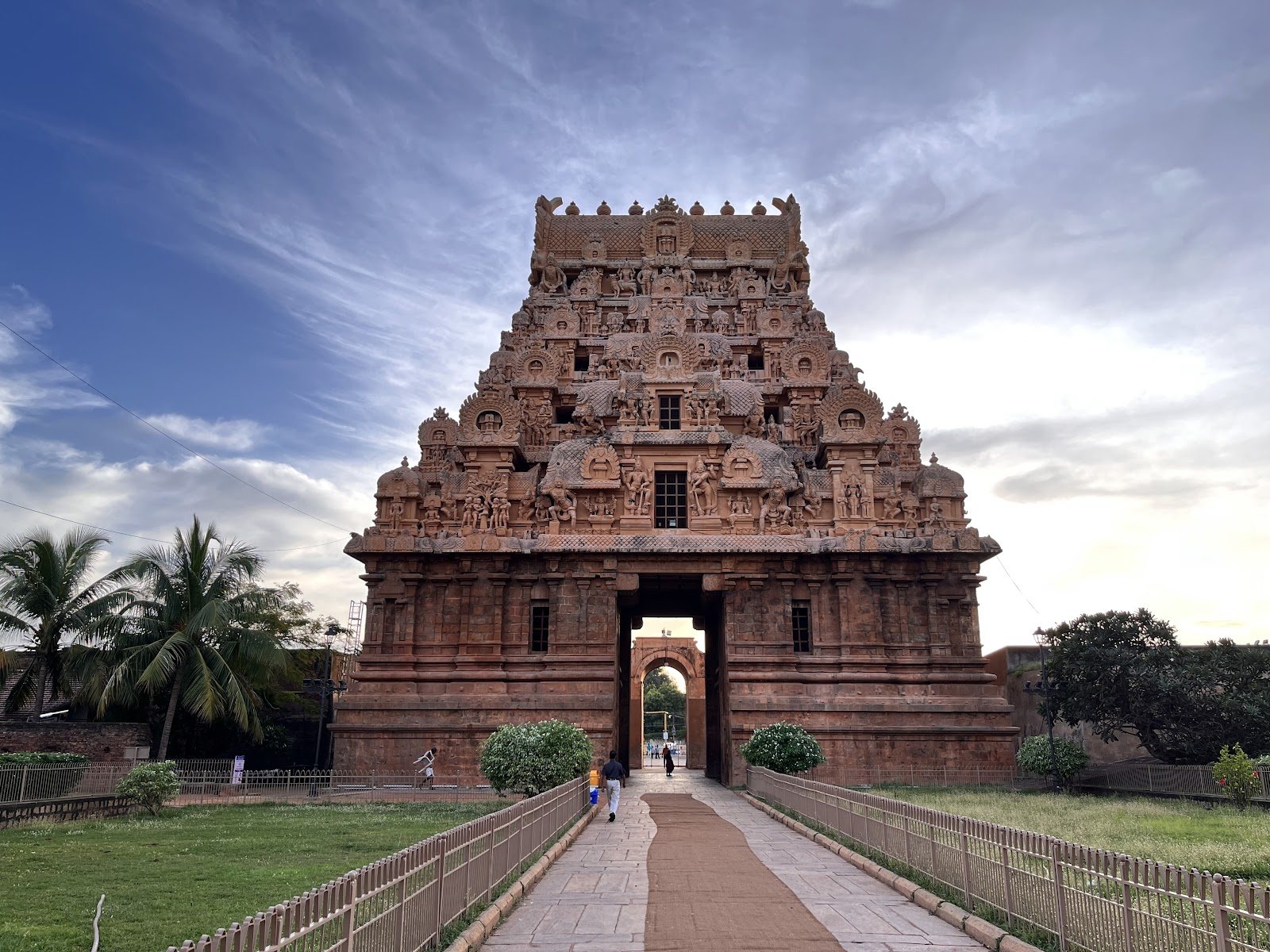
Brihadeeswara Temple stands on the south bank of the Cauvery river in Thanjavur, rising above the surrounding town with an unmistakable sense of quiet majesty. Known locally as Thanjai Periya Kovil or the Big Temple, this extraordinary sanctuary was constructed in granite more than a thousand years ago. It remains one of the grandest examples of Tamil architecture ever built, drawing both daily worshippers and quiet travellers from across the globe.
If you are travelling across Tamil Nadu from Pondicherry, spending a day or two in Thanjavur is well worth the journey. Stepping inside the temple gates lets you walk through quiet pillared corridors, see ancient inscriptions carved into solid stone, and experience a living spiritual tradition that has continued unbroken through the centuries.
At a glance
| Best time of day | Early morning or late afternoon |
|---|---|
| Allow | 2 to 3 hours |
| Dress | Modest clothing covering shoulders and knees |
| Photography | Courtyard allowed; prohibited in sanctum |
| From Pondicherry | roughly 4 hours by road |
The story and significance of the temple
Commissioned by the Chola emperor Rajaraja I between 1003 and 1010 CE, the sanctuary was originally named Rajarajesvaram, which translates to the temple of the god of Rajaraja. A later inscription found in the shrine mentions the name Periya Udaiya Nayanar, giving rise to its popular contemporary names, Brihadeeswara and Peruvudaiyar Kovil. Dedicated to Shiva, the complex is also referred to as Dakshina Meru, the Meru of the South, referencing the sacred mountain of classical Hindu tradition.
The complex is recognized globally as part of the UNESCO World Heritage Site known as the Great Living Chola Temples, a group that also includes the temple at Gangaikonda Cholapuram, located about 70 kilometres to the northeast, and the Airavatesvara temple in Darasuram, roughly 40 kilometres away. Together, these sites represent the height of medieval South Indian architecture, stone carving, and state-sponsored hydraulic engineering across the fertile Kaveri delta.
Over the centuries, the complex survived multiple regional conflicts and repairs. While the core 11th-century structures remain intact, later ruling dynasties respected the symmetry of the original grounds while making careful additions. The Nayakas added shrines dedicated to Kartikeya, Parvati, and Nandi during the 16th and 17th centuries, while the Maratha rulers of Thanjavur maintained and repaired the murals and stonework. In 1777, French colonial forces built defensive outer walls with gun emplacements, briefly using the perimeter as an arsenal.
What to look for across the grounds
The architecture of Brihadeeswara Temple is classified as a Perunkoil, a grand temple built upon an elevated stone platform. Laid out on a clear east-west axis, the complex forms a rectangle measuring nearly 241 metres long by 122 metres wide. Everything about its geometry is orderly and balanced.
The most prominent element is the primary granite vimana, the massive tower standing directly above the central sanctum. Reaching a height of 63.4 metres, it is one of the tallest temple towers in South India. Unlike many later South Indian temples where outer entry gateways dominate the skyline, here the central tower dwarfs the eastern entrance gopuram, which was designed at less than half its height.
- The Nandi Mandapam: A grand pavilion facing the main shrine, housing a monolithic sculpture of Nandi, the sacred bull.
- The inner sanctum: The chamber holds one of the largest Shiva lingas in India, surrounded by ancient circumambulatory passages.
- Pillared veranda: A colonnaded corridor that spans approximately 450 metres along the courtyard wall, sheltering dozens of subsidiary shrines and carved stone lingas.
- Side shrines: Smaller shrines honoring Ganesha, Kartikeya, Parvati, Dakshinamurti, Sabhapati, Varahi, Chandeshvara, and Siddhar Karuvoorar.
- Carvings and murals: Stone reliefs illustrating deities from Shaivite, Vaishnavite, and Shakti traditions, accompanied by historical Chola and Nayaka wall paintings.
Local tip: Take time to examine the lower plinth along the main sanctuary. Detailed Tamil inscriptions run along the granite base, documenting royal donations, temple staff, and everyday life during the Chola dynasty.
How to plan your walk through the complex
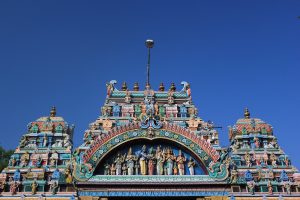
You enter the grounds from the east, passing through the historic perimeter fortifications and beneath the barrel-vaulted entrance gopuram. Before stepping onto the inner courtyard paving, you will leave your footwear at the designated shoe stalls located near the entrance. From there, the wide, open stone courtyard spreads out before you.
Visitors usually follow a clockwise path around the compound. You can begin by admiring the large Nandi pavilion before ascending the steps that lead into the community hall (mukhamandapam) and the great assembly hall (mahamandapam). These covered halls lead directly toward the antrala pavilion and the inner sanctum.
Daily worship services and rituals take place at set times throughout the day, including the offering of lamps, chanting of traditional hymns, and the bathing of deities. Non-worshippers are welcome to observe quietly from the corridors and outer halls. However, the inner sanctum remains an active devotional area, and visitors are expected to maintain an unhurried, respectful demeanor.
| Area | Primary Highlight |
|---|---|
| Courtyard Perimeter | 450-metre covered veranda lined with sculpted stone pillars |
| Eastern Entrance | Barrel-vaulted 11th-century gateway structure |
| Nandi Pavilion | Large monolithic stone bull facing the inner sanctum |
| Central Vimana | Towering 63.4-metre granite structure above the main deity |
Temple etiquette and dress code
Brihadeeswara Temple is an active place of daily worship where local devotees come to pray, meditate, and make offerings. Approaching the grounds with quiet mindfulness ensures that the sacred atmosphere remains undisturbed for everyone present. Following a few simple customs regarding dress, footwear, and personal conduct will make your visit pleasant and comfortable.
- Footwear: Shoes and sandals must be removed before entering the courtyard. Small, secure shoe-keeping counters operate outside the gate.
- Clothing: Wear conservative, modest attire that covers both your shoulders and your knees. Traditional Indian dress such as dhotis, kurtas, sarees, and salwar suits are customary, though modest casual trousers and long skirts are acceptable.
- Photography: Taking pictures is generally permitted in the open courtyards and around the exterior architecture. Photography is strictly prohibited inside the inner sanctum and during certain devotional ceremonies.
- General conduct: Keep your voice lowered in covered halls, turn your mobile phone to silent, and always walk clockwise around shrines.
Best time to visit and how long to stay
The temple opens in the morning, closes during the hottest hours of midday, and reopens in the late afternoon until night. Exact opening hours vary depending on festival days and temple administration rules, so it is sensible to check current timings locally upon arriving in Thanjavur.
Early morning, right as the gates open, is the most peaceful time to walk the grounds. The air is cool, the granite flags underfoot are comfortable to walk on without shoes, and the soft dawn light casts long shadows across the stone carvings. The late afternoon is equally lovely, as the golden evening light illuminates the high vimana.
Plan to spend between two and three hours on site. This allows plenty of time to explore the main hall, view the surrounding shrines, study the inscriptions, and sit quietly in the colonnaded corridors.
Travelling from Pondicherry and staying nearby
Thanjavur sits roughly 170 kilometres southwest of Pondicherry. The drive takes about four hours by private car or taxi, winding south past Cuddalore, Chidambaram, and Kumbakonam along national and state highways. If you prefer public transit, regular government buses connect Pondicherry to Thanjavur, or you can take a bus to Kumbakonam and transfer for the final short leg.
For travellers arriving by air, Tiruchirappalli International Airport is the nearest terminal, located about 55 kilometres to the west. Thanjavur is also well linked to Chennai, Madurai, and Tiruchirappalli by daily Indian Railways train services.
Thanjavur offers a range of family-run guesthouses, boutique heritage stays, and dependable mid-range hotels, many located within a ten-minute drive of the temple entrance. Staying overnight in Thanjavur lets you experience both a sunset visit and an early morning walk before the tour groups arrive.
Combining your trip with regional sights
Because Thanjavur sits near the heart of the Kaveri delta, you can easily pair your trip to Brihadeeswara Temple with other remarkable historic stops. Gangaikonda Cholapuram, built by Rajaraja’s son Rajendra Chola I, lies about 70 kilometres northeast. Further east, near Kumbakonam, sits the Airavatesvara temple at Darasuram, famed for its delicate miniature carvings. Together with Brihadeeswara, these three form the UNESCO-listed Great Living Chola Temples.
Within Thanjavur itself, consider stopping by the Thanjavur Royal Palace complex and the Saraswathi Mahal Library to view centuries-old manuscripts, bronze figures, and regional paintings.
Between sightseeing, stop at a local South Indian mess or coffee shop in town. A fresh cup of frothy filter coffee served with crispy medu vada or hot idlis makes a wonderful mid-morning pause before continuing your journey through Tamil Nadu.
What recent visitors say
A quick, honest snapshot from recent Google reviews, so you know what to expect before you go.
What people loved
★★★★★ Sakthi · in the last week
“Excellent place to visit… mesmerizing to see that this was built 1000 years back…if Egpyt has the pyramids we are proud to have such temples across India. Sunset view from the parking area is very good. No entry fee!! Clean toilets!…”
★★★★★ sunil · in the last week
“Amazing and fascinating… our ancestors were far more advanced that what we are today….”
★★★★★ Nikhil · a month ago
“Brihadeeswara Temple, Thanjavur – A Marvel Beyond Words If there is one place in India that truly shows the greatness of Tamil culture and Chola architecture, it is the Brihadeeswara Temple in Thanjavur. This is not just a temple; it is a…”
Reviews via Google Maps. Opinions are those of their authors.
Frequently asked questions
Is non-Hindu entry permitted inside Brihadeeswara Temple?
Yes, visitors of all backgrounds and faiths can enter the temple complex and explore the outer courtyards and pillared halls. As with most active temples in Tamil Nadu, access right into the innermost sanctum during special worship may be restricted to devotees, so please follow local guidance.
What is the best way to handle hot stone floors during sunny hours?
The open granite courtyard can become quite warm by midday. To avoid discomfort, visit early in the morning or later in the afternoon, or walk along the covered pillared verandas that run the entire perimeter of the courtyard.
Can I visit Brihadeeswara Temple as a day trip from Pondicherry?
A day trip is possible if you leave early in the morning, as the drive takes about four hours each way. However, staying overnight in Thanjavur is much more relaxed and allows you to experience the temple in both the morning and evening light.
Are guides available at the temple entrance?
Authorized local guides frequently offer their services near the main entrance gates. If you wish to hire one, agree upon the fee and the duration of the tour before setting out across the complex.
Find it
Address: Balaganapathy Nagar, Thanjavur, Tamil Nadu 613001, India