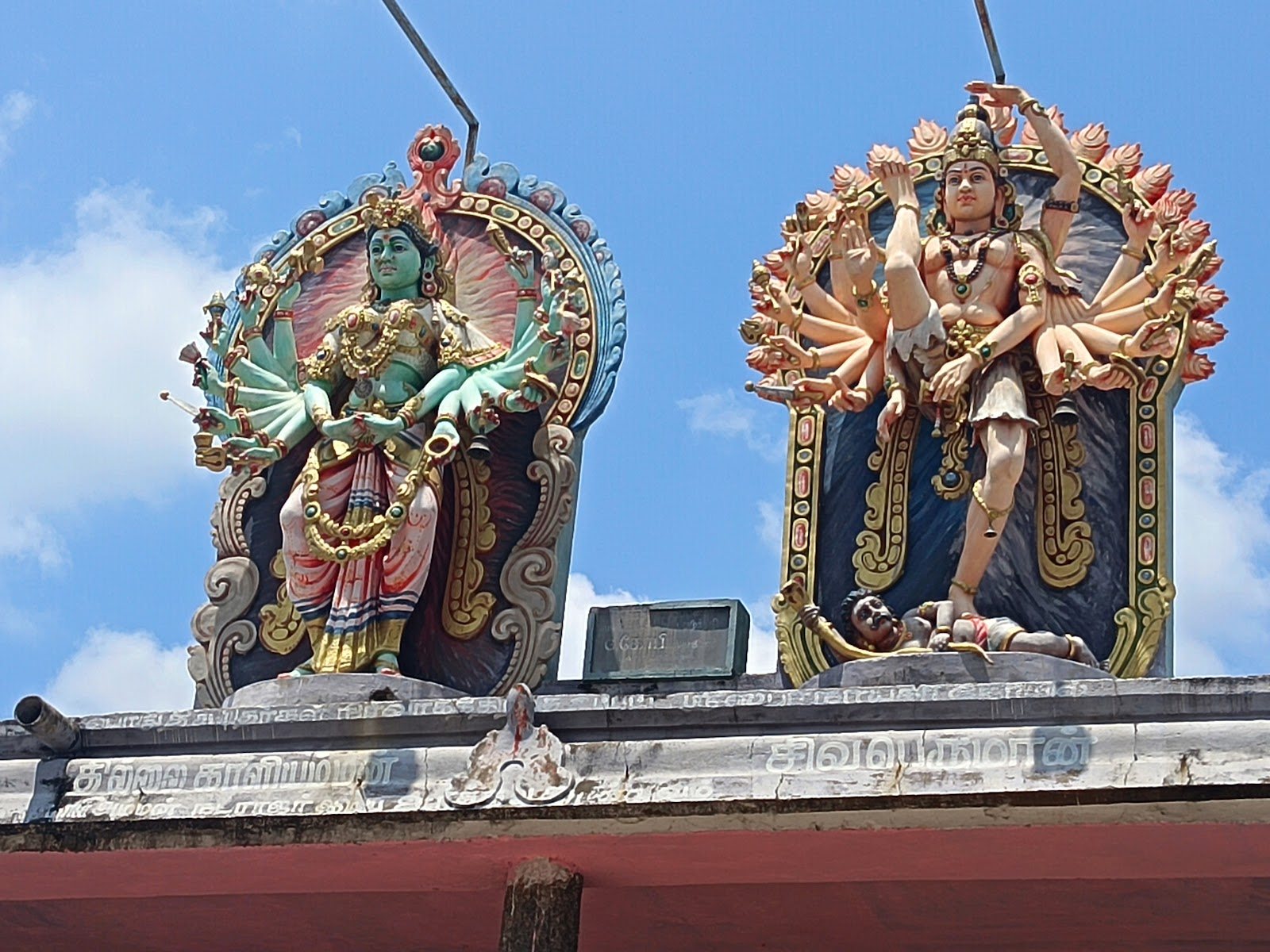
Thillai Nataraja Temple stands at the heart of Chidambaram, roughly sixty-five kilometres south of Pondicherry. Known simply as Kovil, or “The Temple”, among followers of Tamil Shaivism, this historic complex honours Shiva as Nataraja, the cosmic dancer. It is one of the rare shrines where classical sacred dance, early Dravidian stonework, and living temple rituals remain closely intertwined.
A day journey here from Pondicherry gives you a direct encounter with an active pilgrimage site that has shaped south Indian art and devotion for centuries. Walking through its tall gateway towers, you step out of the town streets and into wide granite halls that have sheltered worshippers since the days of the early Chola kings.
At a glance
| Best time of day | Early morning (6:30 AM to 8:30 AM) or early evening (5:30 PM to 7:30 PM) |
|---|---|
| Allow | 2 to 3 hours |
| Dress | Modest traditional clothing; men must remove shirts for the inner sanctum |
| Photography | Strictly prohibited inside the complex and sanctum |
| From Pondicherry | roughly 65 kilometres (about 1.5 to 2 hours) by road |
Why this place matters
The town of Chidambaram took its ancient name, Thillai, from the mangrove forests of tillai trees that once grew across this coastal flatland. The modern name Chidambaram comes from chit, meaning wisdom or consciousness, and ambalam, meaning open hall or atmosphere. Worshippers often describe the temple as the stage of consciousness, where the supreme reality is experienced as both sound and space.
In sacred geography, the temple belongs to the Pancha Bhoota Sthalams, a group of five historic Shiva temples in southern India that embody the natural elements. Chidambaram represents akasha, or space and ether, which is considered the subtlest of all the elements. It is also celebrated as part of the Pancha Sabha Thalam, making it the only Shiva temple shared by both of these major traditions.
Early Tamil hymns by the Nayanar poets Appar and Sambandar celebrate the dancing god here as early as the sixth and seventh centuries. When the Chola dynasty rose to prominence, their rulers adopted Nataraja as their family deity and made Chidambaram an early imperial centre. Parantaka Chola I covered the central shrine roof with beaten gold plates in the tenth century. Successive Chola, Pandya, and Vijayanagara monarchs added courtyard walls, mandapas, and towering gopurams across several centuries, preserving the site as a focal point of southern spiritual life.
What you will see across the grounds
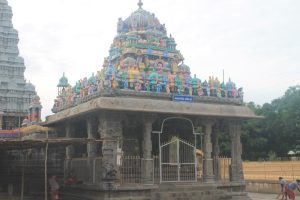
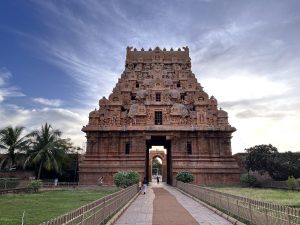
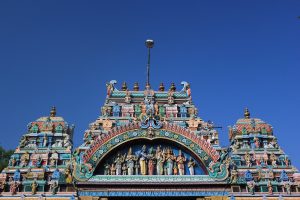
The temple grounds cover about forty acres enclosed by double boundary walls. Four monumental gopurams rise above the north, south, east, and west gates. If you pause under the gateways, look closely at the interior stone pilasters: sculptors carved the complete set of 108 karanas, the fundamental classical dance movements recorded by Bharata Muni in the ancient Natya Shastra. These carvings provided the visual vocabulary for modern Bharatanatyam.
At the centre sits the Chit Sabha, the wooden and gold-roofed sanctum where Shiva is worshipped as Nataraja performing the Ananda Tandava, or dance of delight, alongside his consort Sivakami Amman. Directly adjoining this sacred space is the shrine of Govindaraja Perumal, dedicated to Vishnu. Chidambaram is one of the rare temple complexes where Shaiva and Vaishnava shrines sit side by side in the inner court.
The complex contains five principal sabhas, or halls, each serving an ancient ceremonial role:
- Chit Sabha: the innermost sanctum with its gilded roof, where the main deity resides.
- Kanaka Sabha: the golden hall situated directly in front of the sanctum, where daily services take place.
- Nritta Sabha: a delicately carved stone hall resting on wheels and drawn by sculpted horses, honouring the dance contest between Shiva and Kali.
- Deva Sabha: the gathering hall used for processing sacred festival deities.
- Raja Sabha: the vast thousand-pillared hall in the outer court, used for state gatherings, coronation rites by historical rulers, and major festival assemblies.
Beside the Raja Sabha lies the Sivaganga, a large rectangular temple pool lined with granite steps. Shrines honouring Ganesha, Murugan, Surya with his chariot, and an early separate Amman temple are distributed through the secondary courts, providing quiet places to sit and observe the architecture away from the main lines.
How a visit works
Most visitors enter through the East or South Gopuram. Before stepping past the threshold, you must leave your footwear at the designated shoe counters outside the gates. A nominal token fee is usually collected there. Once inside, walking barefoot on the smooth stone flagstones is standard practice throughout the forty-acre grounds.
The temple opens twice each day: first from 6:00 AM until noon, and again from 5:00 PM until 10:00 PM. General entry is free, and you can wander the outer courts and join the standard darshan queue without paying anything. During festival periods or busy weekends, special queue tickets are sometimes offered to speed up movement near the sanctum; prices vary, so look for local notices near the inner entrance.
Inside the Chit Sabha, priests carry out regular puja services with chanting, bell-ringing, and camphor lamps. Behind the main image hangs a dark curtain adorned with golden bilva leaves. This curtain conceals an empty space known as the Chidambara Rahasyam, the secret of Chidambaram. When priests momentarily draw the curtain aside during specific rituals, worshippers bow before the empty space, honouring the divine as formless, infinite consciousness.
Etiquette and what to wear
Because this is an active place of daily worship, conservative clothing is essential. Men should wear dhotis, cotton pyjamas, or modest trousers; women should wear sarees, long skirts, or salwar kameez. Short dresses, tank tops, and shorts are not permitted.
Men must remove their shirts and vests before entering the innermost courtyards and the central sanctum. You can carry your shirt over your arm or shoulder while inside. Non-Hindu visitors are welcome to explore the extensive courtyards, view the stone towers, and observe the shrines from outside, though access into the innermost sanctum enclosure may be restricted during certain peak rites.
Local tip: Keep mobile phones turned off or silent in your bag. Photography is strictly prohibited throughout the temple compound, and security staff will reprimand anyone attempting to take pictures or film rituals with their phones.
Keep your voice low, walk clockwise around the shrines as is customary in Hindu temples, and avoid walking directly between a praying worshipper and the deity.
Best time to go and how long to stay
Plan your arrival either around 6:30 AM when the morning rituals begin, or around 5:30 PM as the day cools down. The midday sun can heat the courtyard granite significantly, making it uncomfortable to walk barefoot between 10:30 AM and 3:30 PM. A relaxed walk around the monuments, halls, and tank takes about two to three hours.
Major religious festivals draw large numbers of devotees and alter the regular visiting rhythm:
| Festival | Timing | What to Expect |
|---|---|---|
| Natyanjali Dance Festival | February to March (Maha Shivaratri) | Classical dancers perform in the temple courtyards over several evenings. |
| Aani Thirumanjanam | June to July | Elaborate day-long bathing rituals and processions of the main deities. |
| Arudra Darshanam | December to January (Margazhi) | Major annual festival celebrating the cosmic dance, with huge pilgrim crowds. |
Getting there from Pondicherry and where to stay nearby
Chidambaram sits roughly sixty-five kilometres south of Pondicherry along National Highway 32. Hiring a private taxi from Pondicherry is the most straightforward option; the drive takes about an hour and a half to two hours depending on local traffic. Regular state transport buses also run between the Pondicherry main bus stand and Chidambaram bus station throughout the day.
Daily passenger and express trains connect Chidambaram railway station, which sits about two kilometres from the temple gates, to regional hubs across Tamil Nadu. For air travel, Pondicherry airport is about sixty kilometres north, while major international flights use Chennai airport roughly 230 kilometres away or Tiruchirappalli airport about 165 kilometres to the southwest.
Because Chidambaram is an easy day excursion, most international travellers prefer to stay in Pondicherry and travel down for the morning or evening. If you want an early start for the sunrise darshan, modest lodging options and pilgrimage guesthouses line the car streets surrounding the temple towers.
Nice to combine with
Just fourteen kilometres east of Chidambaram lie the Pichavaram Mangrove Forests, one of the largest mangrove systems in India. You can hire rowboats or motorboats through the forest department to drift through narrow water channels beneath the dense tillai and rhizophora tree canopies.
If you enjoy temple architecture, consider driving roughly forty-two kilometres southwest to Gangaikonda Cholapuram. Built by Rajendra Chola I, this massive granite temple offers quiet lawns and remarkable eleventh-century stone carvings without large crowds. Other noteworthy stops nearby include the ancient shrines at Sirkazhi, about twenty kilometres south, and Vaitheeswaran Koil, roughly twenty-five kilometres away.
Local tip: Before heading back north toward Pondicherry, stop at one of the traditional vegetarian mess halls near the West Car Street for hot filter coffee and freshly made south Indian thalis served on banana leaves.
What recent visitors say
A quick, honest snapshot from recent Google reviews, so you know what to expect before you go.
What people loved
★★★★★ Mayuresh · 2 months ago
“You must visit this place.. Beautifully designed worship place.. One of the biggest temples in India.. Lord Nataraj temple, lord Venkateshwara temple, goddess Lakshmi Temple, Kartik swami temple and many more in one campus.. Sit with your…”
★★★★★ Kamalakanta · 3 months ago
“I visited Thillai Nataraja Temple in Chidambaram and had a truly enriching spiritual experience. The temple is renowned for its magnificent architecture, rich history, and deep religious significance. The intricate carvings, towering…”
★★★★★ Chethan · 3 months ago
“Thillai Nataraja Temple in Chidambaram is one of the most revered temples dedicated to Lord Shiva in his cosmic dancer form, Nataraja. The temple is renowned for its magnificent Dravidian architecture and rich spiritual heritage. Thousands…”
Reviews via Google Maps. Opinions are those of their authors.
Frequently asked questions
Can non-Hindus enter Thillai Nataraja Temple?
Yes, non-Hindu visitors are welcome inside the broad temple courtyards and may observe the architecture and outer mandapas. Entry into the innermost sanctum area directly in front of the deity can sometimes be restricted depending on the rituals in progress.
Is photography allowed anywhere inside the temple?
No, photography and video recording are strictly forbidden everywhere within the temple complex. You should keep cameras and mobile phones stored securely in your pocket or daypack.
What is the dress code for visitors?
Visitors must wear modest, conservative attire covering shoulders and knees. Men are required to take off their shirts before entering the inner sanctum enclosures, while women typically wear sarees, salwar suits, or ankle-length skirts.
How far is Chidambaram from Pondicherry?
Chidambaram is roughly sixty-five kilometres south of Pondicherry. The trip along National Highway 32 takes about an hour and a half to two hours by private car or public bus.
Find it
Address: Chidambaram, Tamil Nadu 608001, India
You might also like
- Where to stay in Pondicherry
- Churches, temples, mosques and ashrams in Pondicherry
- Sri Karneshwar Nataraja temple
- Saneeswarar Temple
- Sri Aurobindo Ashram
- Things to do in Pondicherry
- Visiting Adiyogi in Semmedu: A Practical Guide
- Visiting the Vivekananda Rock Memorial in Kanniyakumari
- Visiting Varadaraja Perumal Temple in Kanchipuram