A journey to Thanjavur Palace brings you directly into the administrative and cultural heart of the Kaveri delta. Locally known as Thanjavur Aranmanai, this expansive complex combines high masonry towers, wide courtyards, and pillared halls that served both Nayak and Maratha rulers for centuries. It remains a living piece of regional heritage where descendants of the royal family still reside in private quarters alongside public museums.
If you are travelling inland from Pondicherry, the palace makes an essential stop on any cultural itinerary. The site offers a slower, reflective counterpoint to the towering stone gopurams of the nearby temples. Here you can wander through historic libraries, study ancient bronze castings, and admire wall paintings that record the artistic tastes of South Indian royalty.
At a glance
| Best time of day | Morning around 10:00 AM or mid-afternoon after 2:30 PM |
|---|---|
| Allow | 2 to 3 hours |
| Dress | Modest clothing covering shoulders and knees |
| Photography | Allowed in courtyards with a fee; restricted in the library and select galleries |
| From Pondicherry | roughly 170 km, about 4 hours by road |
The story behind the royal seat
The foundations of the palace go back to the 16th century when the Thanjavur Nayaks ruled the region as governors under the Vijayanagara Empire. In 1673, open conflict erupted between Chokkanatha Nayak of Madurai and Vijayaraghava Nayaka of Thanjavur, leading to the fall of the Thanjavur Nayak line. Following an appeal for outside intervention, the Sultan of Bijapur dispatched an army led by the Maratha general Venkoji Bhonsle, also known as Ekoji I.
Venkoji, a half-brother of the Maratha ruler Shivaji, defeated the local forces at Ayyampet. Rather than handing control back to a Nayak claimant, he assumed personal sovereign power in early 1676, founding the Thanjavur Maratha dynasty. The palace became the royal residence and administrative centre of the Bhonsle kingdom, which presided over the fertile Kaveri delta until the mid-nineteenth century.
Under rulers like Shahuji I and Serfoji I, the court became a renowned gathering place for poets, musicians, and scholars writing in Marathi, Sanskrit, Telugu, and Tamil. The most celebrated scholar-king of the line was Serfoji II. After ceding civil and military authority to the British East India Company under the treaty of 1799, Serfoji II retained jurisdiction over the palace complex and dedicated his life to science, medicine, and the arts. When the last titular ruler, Shivaji, died without a direct male heir in 1855, the British annexed the territory under the Doctrine of Lapse, leaving the palace in the care of royal descendants and later state institutions.
What to look for across the palace complex
Because the complex grew across different reigns, the architecture shows a clear synthesis of Nayak brickwork and Maratha decorative tastes. Stucco figures line the cornices, vaulted brick corridors stay cool in the midday heat, and colourful plasterwork adorns the public halls. Several distinct areas within the grounds deserve your attention.
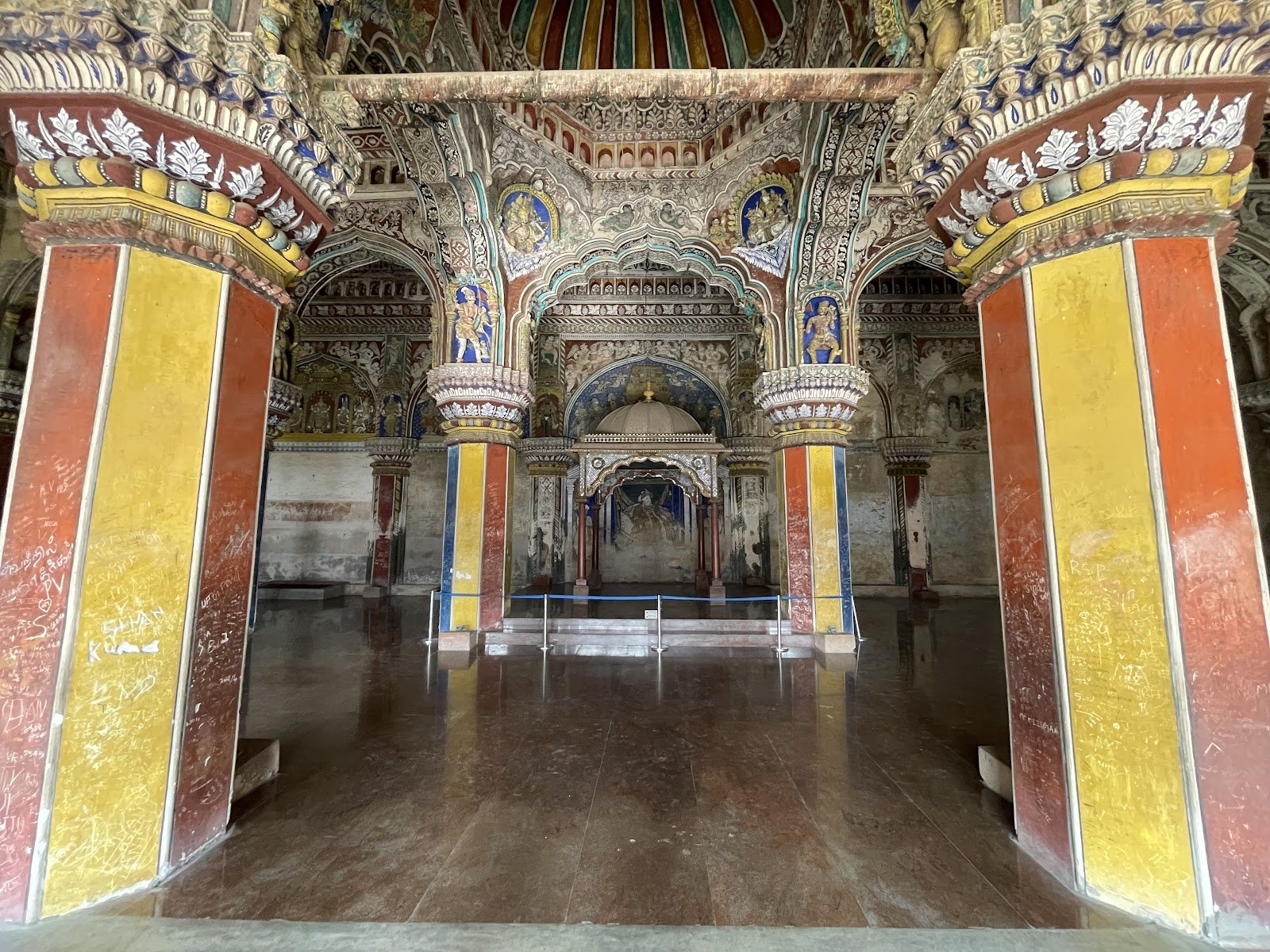
- The Mahratta Darbar Hall features ornate stucco plasterwork, painted ceilings depicting scenes from Hindu epics, and official portraits of the Maratha kings along the back wall.
- The Saraswathi Mahal Library preserves an internationally important collection of ancient palm-leaf manuscripts and rare paper books gathered and organized by Raja Serfoji II.
- The Thanjavur Art Gallery, set in a historic pillared pavilion, displays a remarkable collection of stone statues and Chola-era lost-wax bronze sculptures.
- The Arsenal Tower, also called the Gooda Gopuram, rises above the palace grounds as a multi-tiered defensive structure used for military storage and watchkeeping.
- The Bell Tower, known as Madamaligai or Sarajah Madi, provides an impressive example of multi-storey Nayak palace architecture.
- The Sangeetha Mahal is an ornate historic auditorium engineered with curved masonry surfaces designed to carry the sound of classical instruments and vocal music.
Take your time walking through the Mahratta Darbar Hall to examine the painted woodwork and stone pillars. The ceilings carry intricate depictions of deities and royal courts executed with natural mineral pigments that have survived for over two centuries.
Within the Saraswathi Mahal Library, you can view glass display cases holding illustrated treatises on astronomy, grammar, medicine, and military strategy. It is considered one of the oldest functioning manuscript libraries on the continent. Just across the open courtyard, the Thanjavur Art Gallery lets you observe the delicate features and fluid postures of centuries-old bronze figures cast during the height of the Chola empire.
Local tip: Look closely at the stucco relief work on the upper walls of the open courtyards. You can see small painted figures of court dancers, musicians, and soldiers dressed in 18th-century Maratha military attire.
How to navigate your visit
The palace is located within the old fortified quarter of Thanjavur, accessible through wide stone gateways. Once inside, you will find yourself in an open central compound connecting the various historical wings. While the buildings form a single broad complex, different sections are administered by separate trusts and departments.
You will need to buy entry tickets at the designated counters near the main entrance. Depending on what you want to see, ticket options can include separate tickets or composite admissions covering the Art Gallery, the Darbar Hall, and the Library museum rooms. Keep cash on hand as card machines may not always have a reliable connection.
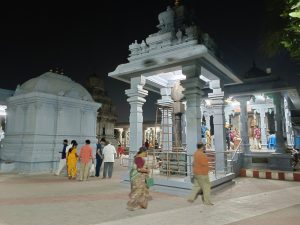
The complex also houses the private Chandramauleeshwarar Temple, dedicated to Lord Shiva as the family deity of the Maratha royal household. Visitors may respectfully observe the temple courtyard from the outside, though access to the inner sanctum remains governed by royal family traditions.
Etiquette, dress code, and local rules
Even though much of the palace functions as a museum today, it remains culturally significant and houses active family shrines. Dressing respectfully helps maintain the decorum of the site. Wear clothes that cover your shoulders and knees. Light cotton trousers, linen shirts, and long skirts or salwar kameez are practical choices for the inland warmth.
You are free to wear footwear while walking through the open courtyards, paved exterior corridors, and stone staircases. However, you must take your shoes off before stepping inside designated gallery spaces, manuscript viewing rooms, and active temple sanctums. Shoe stands are placed near the entrances of these sections.
Non-Hindu visitors are welcome throughout all secular palace halls, the library, and the museum galleries. Respectful visitors are also permitted in the common courtyard of the royal temple.
Photography is permitted in the open courtyards and public corridors after paying a nominal camera fee at the ticket desk. However, photography is strictly prohibited inside the Saraswathi Mahal manuscript halls and inside sensitive sections of the bronze gallery to protect the artefacts. Always look for signage before using a camera or phone.
When to visit and time to budget
The palace grounds generally open daily between 9:00 AM or 10:00 AM and close around 5:00 PM or 6:00 PM. It is important to know that individual sections, such as the Saraswathi Mahal Library and the Art Gallery, observe an afternoon break, often closing between 1:00 PM and 1:30 PM or 2:00 PM. Certain library reading rooms may also close on select public holidays. Visiting right around 10:00 AM allows you to see the indoor collections before the midday closure.
Plan to spend between 2 and 3 hours to comfortably explore the grounds without rushing. If you enjoy examining historic manuscripts or studying bronze sculpture in detail, you could easily spend half a day here.
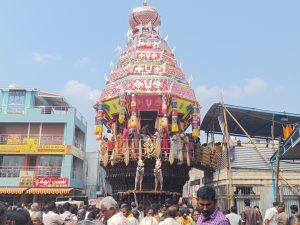
Regional festivals bring an extra sense of occasion to Thanjavur. The town sees grand community celebrations during Pongal in mid-January, Navaratri and Vijayadashami in the autumn, and Maha Shivaratri in February or March. The palace area can be busier during these festival weeks.
Travelling from Pondicherry and where to stay
Thanjavur sits roughly 170 kilometres southwest of Pondicherry. The drive takes about 4 hours by private car or taxi, carrying you through the rural landscapes of the lower Kaveri basin. You can travel via the route passing through Panruti, Neyveli, and Kumbakonam, which offers pleasant views of delta paddy fields.
If you prefer public transit, regular state buses run from Pondicherry to Thanjavur throughout the day. Alternatively, you can take a passenger train from Villupuram Junction to Thanjavur Junction, which sits roughly 2 to 3 kilometres from the palace gates. For air travellers, the closest airport is Tiruchirappalli International Airport, located roughly 55 to 60 kilometres to the west.
For accommodation, central Thanjavur has a solid selection of heritage hotels, comfortable modern guest houses, and budget lodges. Staying near the old town allows you to walk or take a short auto-rickshaw ride to both the palace and the historic temple quarters.
What to see nearby
You can easily combine your palace visit with several other historic landmarks in the immediate neighbourhood:
- Brihadeeswarar Temple (the Big Temple): This grand 11th-century Chola granite temple sits approximately 1.5 kilometres away and represents one of South India’s greatest architectural achievements.
- Sivaganga Park and Tank: Located roughly 1.5 kilometres from the palace, this historic reservoir and garden area offers shaded walking paths along the water.
- Schwartz Church: Situated about 1 kilometre away, this 18th-century church was commissioned by Raja Serfoji II in honour of his Danish missionary tutor, Christian Friedrich Schwarz.
After a morning of walking, stop by one of the traditional vegetarian restaurants along South Main Street for a South Indian thali served on a banana leaf, followed by a glass of freshly brewed Kumbakonam-style filter coffee.
Frequently asked questions
Can non-Hindus visit the Thanjavur Palace complex?
Yes. Non-Hindu visitors are welcome to explore all the museum galleries, the Saraswathi Mahal Library, and the public palace grounds without restriction.
Is photography allowed inside the palace?
Photography is permitted in the open courtyards and several exterior halls upon paying a nominal camera fee. It is strictly prohibited inside the Saraswathi Mahal manuscript halls and select sections of the bronze gallery.
How far is Thanjavur Palace from Brihadeeswarar Temple?
The palace is located approximately 1.5 kilometres from Brihadeeswarar Temple. You can travel between them in under ten minutes by auto-rickshaw or take a pleasant 20-minute walk through town.
Do I need separate tickets for different sections of the palace?
Yes, different wings such as the Art Gallery, the Durbar Hall, and the Saraswathi Mahal Library operate under distinct trusts and departments. You may need to purchase individual or composite tickets at the counters.
Find it
Address: Q4RP+HC5, Rajakrisnapuram, Thanjavur, Tamil Nadu 613009, India