Sri Sarangapani Swamy Temple is one of the grandest Vaishnavite shrines in south India, located right in the center of Kumbakonam. If you are travelling inland from Pondicherry to explore the temple towns of the Kaveri Delta, this sacred site stands out for its stone carving, lofty gateway, and centuries of daily devotion.
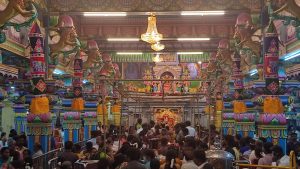
The temple honors Lord Vishnu in a rare, half-reclining posture holding a bow. Stepping past the massive wooden doors brings you into cool pillared stone halls where priests chant ancient verses, brass lamps flicker, and town life settles into a slow, reverent pace.
At a glance
| Best time of day | Early morning between 7:00 AM and 9:00 AM |
|---|---|
| Allow | 1 to 2 hours |
| Dress | Traditional attire; dhoti, kurta, saree, or salwar kameez |
| Photography | Strictly prohibited inside the inner complex and sanctum |
| From Pondicherry | roughly 135 km (about 3.5 to 4 hours by road) |
The story and significance of the shrine
This shrine holds a venerable place in South Indian spiritual life and sacred geography. It is counted among the 108 Divya Desams, the holy Vishnu temples praised in the classical verses of the Tamil Alvar poet-saints. It is also celebrated as one of the Pancharanga Kshetrams, five revered riverside sanctuaries scattered along the Kaveri River basin where the deity is worshipped in a reclining form.
Beyond its geography, the temple marks a foundational turning point in Tamil religious literature. In the ninth century, a scholar named Nathamuni came here and heard wandering devotees recite a single hymn by Nammazhwar dedicated to the deity, addressing him affectionately as Aravamudhan. Deeply moved by the beauty of the poetry, Nathamuni set out across Tamil lands to recover the rest of the lost verses, eventually compiling the complete four-thousand-stanza canon known as the Nalayira Divya Prabandham.
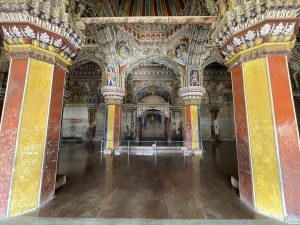
Over many centuries, great royal dynasties took turns expanding the grounds and enriching the stone halls. Rulers from the Chola dynasty, the Vijayanagara Empire, and the Madurai Nayaks commissioned towering gates, stone courtyards, and detailed relief carvings, leaving behind an extraordinary record of regional craftsmanship.
Chariots and towers: what to notice inside
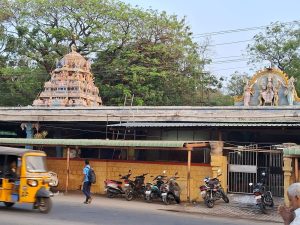
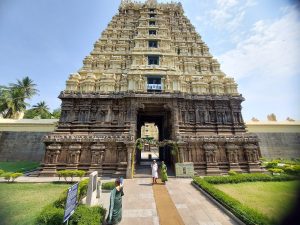
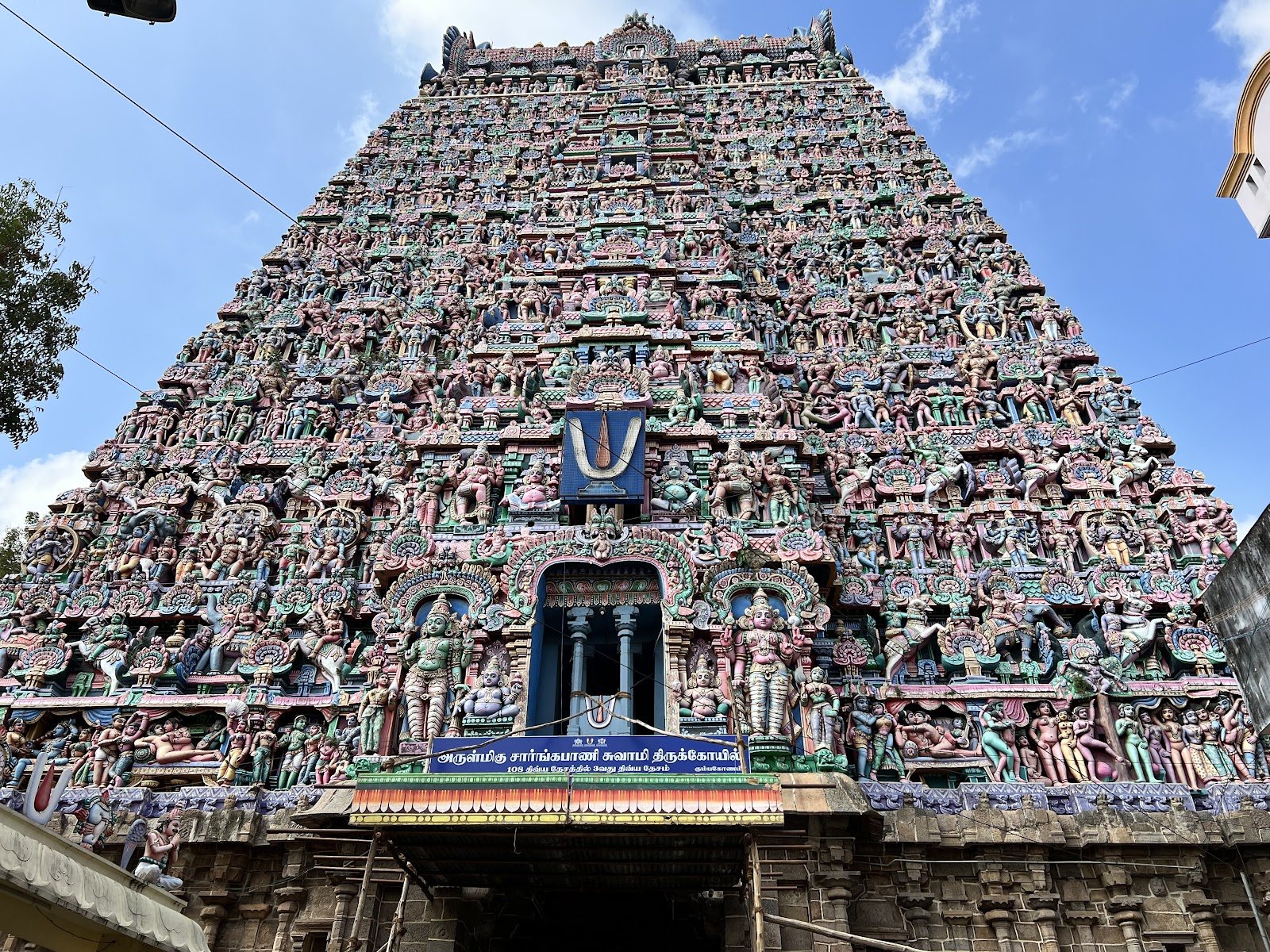
As you approach from the east along the market street, look up at the massive Rajagopuram. Rising eleven tiers to a height of 173 feet (53 meters), it is the tallest temple tower in Kumbakonam. Its brick and stucco levels carry hundreds of sculpted figures illustrating scenes from Vaishnavite lore, glowing softly in the early morning sunlight.
Once inside, the centerpiece of the compound is the main sanctum, built to resemble a massive stone chariot. Stone wheels with carved spokes sit along the plinth, while finely sculpted horses and elephants appear to pull the sanctum forward. This chariot-shaped vimana creates a striking sense of movement frozen in heavy stone, a hallmark of late Chola and Vijayanagara design.
The presiding deity, Sri Sarangapani, rests within the sanctum in a posture called Uthana Sayana, appearing to slightly lift his upper body as if about to rise and greet an approaching devotee. In his hand, he carries his divine bow, known as the sarangam. In a separate shrine within the complex, devotees pay respects to Goddess Komalavalli Thayar, the divine consort.
Right beside the temple stands the Potramarai Kulam, or the Golden Lotus Tank. The water reflects the outer walls of the complex, providing an open, airy space where you can pause and catch the breeze before you step into the enclosed stone corridors.
Local tip: Take a moment to examine the stone wheels of the sanctum chariot. The stone hubs, spokes, and trailing traces display an astonishing level of detail carved directly into granite.
How a visit works
Your visit begins outside the eastern tower, where you will leave your footwear at the designated shoe stall before walking through the high gateway. The stone flagstones can warm up under the midday sun, so early morning or late afternoon arrival makes walking barefoot much easier on your feet.
The temple follows an unusual dual-entrance design determined by the solar calendar. Depending on the month of your visit, you will pass through one of two distinct seasonal gateways:
- Uttarayana Vaasal: Used during the sun’s northern transit, roughly from mid-January to mid-July.
- Dakshinayana Vaasal: Used during the sun’s southern transit, covering the remainder of the year.
General entrance to the temple is free. There are often separate lines for special darshan, which charge a nominal ticket fee that can shorten your wait on busy mornings or festival days. You can purchase these tickets at small counters near the inner entrance if you are short on time.
Inside the inner hall, worship is quiet and continuous. Priests offer camphor flames, distribute holy water (theertham) and basil leaves (tulasi), and recite traditional blessings. You can simply join the queue, observe the rituals with quiet respect, and step aside into the pillared corridor once your darshan is complete.
Etiquette, photography, and dress code
Sri Sarangapani Swamy Temple is a living house of prayer, and traditional dress guidelines are strictly observed at the entry gates. Both men and women must dress conservatively to gain entry, and guards will turn away visitors wearing casual western holiday attire.
- Men: Traditional dhotis (veshtis), kurtas with trousers, or formal trousers and a shirt. Men may be asked to remove their shirts or upper garments before entering the sanctum.
- Women: Sarees, half-sarees, or modest salwar kameez suits with a dupatta.
- Prohibited clothing: Shorts, mini-skirts, sleeveless tops, and tight or transparent clothing are strictly forbidden.
All footwear must be taken off and left at the entrance stalls for a nominal coin charge. Keep your phone tucked away on silent mode; photography and video recording are strictly prohibited throughout the inner complex and inside the sanctum.
Non-Hindu visitors are welcome to enter the temple complex provided they adhere to the dress code and behave with decorum. However, access into the innermost sanctum chamber can vary depending on priest supervision and local temple regulations on the day.
Best times to visit and seasonal festivals
The temple is generally open every day during two daily sessions: from 7:00 AM to roughly 12:00 PM or 12:30 PM, and again from 4:30 PM or 5:00 PM to 9:00 PM. Timings vary slightly during special festival days, when morning hours may extend and rituals begin before dawn.
For a calm experience, visit during the early morning hours just after opening. The air is cool, the stone floors are pleasant to walk upon, and morning prayers are conducted with fewer crowds than in the evening.
If you wish to witness grand seasonal celebrations, several major festivals take place throughout the year, drawing thousands of pilgrims from across south India:
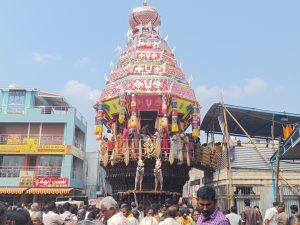
- Chithirai Brahmotsavam (April–May): The grandest annual event, highlighted by the pulling of two massive wooden temple chariots through the town streets.
- Vaikunta Ekadasi (December–January): A major Vaishnavite festival drawing thousands of devotees to celebrate the opening of the celestial doorway.
- Masi Float Festival / Theppotsavam (February–March): Decorated floats carry the deities across the sacred temple tank under the night sky.
- Thai Sankranthi and Ratha Saptami: Auspicious observances held during the winter harvest season with elaborate special decorations.
Getting there from Pondicherry
Kumbakonam sits roughly 135 km south-west of Pondicherry. Driving by private car or taxi takes about 3.5 to 4 hours, winding through the rural agricultural belt of Cuddalore, Neyveli, and Vaitheeswarankoil before reaching the town center. Regular state transport buses also run between Pondicherry and Kumbakonam bus stand throughout the day.
The temple sits right in the town center at Valayapettai Agraharam. If you arrive by train, Kumbakonam Railway Station is roughly 2 km away, an easy five-minute auto-rickshaw ride. For those arriving by air, Tiruchirappalli International Airport is the closest major hub, situated about 90 to 95 km to the west.
Kumbakonam offers plenty of clean, comfortable hotels and budget lodges within walking distance of the central temples, making an overnight stay simple if you want to attend both morning and evening temple sessions without rushing your schedule.
Nearby temples to include in your walk
Because the central part of Kumbakonam is extraordinarily rich in living heritage, you can easily combine your visit to Sri Sarangapani Swamy Temple with several other historic shrines within a short walk or rickshaw ride. The streets around the temple complex are lined with traditional houses, shops selling brass lamps, and small stalls serving traditional snacks, making an exploration on foot very straightforward and rewarding.
- Adi Kumbeswarar Temple: A massive, ancient Shiva temple located roughly 500 meters away, known for its extensive halls and historic stone shrines.
- Chakkarapani Temple: Dedicated to the discus form of Vishnu, situated roughly 1 to 2 km north near the banks of the Kaveri.
- Ramaswamy Temple: Located within 1 km, famous for its stone pillars carved with scenes from the Ramayana epic.
- Mahamaham Tank: The famous sacred reservoir located about 1.5 km south, central to the town’s twelve-year gathering.
Taking time to walk between these historic locations gives you a clear sense of how the town developed around its great reservoirs and sanctums over the centuries, with daily life remaining closely intertwined with temple worship.
Local tip: After your morning temple round, stop by one of the traditional vegetarian eateries near the town bazaar for hot idlis and a brass cup of famous Kumbakonam degree filter coffee.
What recent visitors say
A quick, honest snapshot from recent Google reviews, so you know what to expect before you go.
What people loved
★★★★★ krishna · in the last week
“Very divine. Beautiful vishnu temple. You can have peaceful darahan of aravamudan.. like ranganathar without the rush in srirangam or trivandrum. Dont miss it”
★★★★★ vishal · a month ago
“Sarangpani temple is the grandest temple in the Kumbakonam. It is one of the Divya Desam and I must say a very important Divya Desam. It is also a Panchang Kshetra. It is also a Vaishnav Navgrah sthal linked to planet Surya. The temple is…”
★★★★★ Jagadeesh · a month ago
“Had a peaceful and blessed darshan of Sri Sarangapani (Lord Vishnu) and Goddess Komalavalli (Goddess Lakshmi) at the Sri Sarangapani Temple, Kumbakonam, this morning. 🙏 The temple opened around 7:00 AM, and we had a peaceful darshan. Sri…”
Reviews via Google Maps. Opinions are those of their authors.
Frequently asked questions
What are the visiting hours of Sri Sarangapani Swamy Temple?
The temple is generally open daily from 7:00 AM to 12:00 PM or 12:30 PM, and again from 4:30 PM or 5:00 PM to 9:00 PM. Timings vary on festival days and during special rituals.
Can non-Hindus enter the temple?
Non-Hindu visitors are welcome inside the outer complex provided they follow the traditional dress code and respect worship traditions. Access to the innermost sanctum may vary according to temple regulations.
Is photography permitted on the temple grounds?
Photography and videography are strictly prohibited inside the inner complex and the sanctum. You should keep cameras and mobile phones stored safely in your bag.
How far is the temple from Kumbakonam Railway Station?
The temple is located about 2 km from Kumbakonam Railway Station, which takes roughly five to ten minutes by auto-rickshaw.
Find it
Address: X95G+R4X, Taluk, Valayapettai Agraharam, Kumbakonam, Tamil Nadu 612001, India