Sri Ramanasramam is one of the most quiet, contemplative places you can visit in Tamil Nadu. Located along the base of Arunachala hill in Tiruvannamalai, this ashram was built around the daily life and teachings of Bhagavan Sri Ramana Maharshi. People travel here from all over the world, not for spectacle, but to sit in shared quiet and practice simple self-reflection.
If you are staying in Pondicherry, making the journey west into the interior of the state is a straightforward and rewarding trip. The coastal salt air gives way to broad granite plains and dry scrub hills. Arriving at the ashram offers a complete change of pace, centering on stone walkways, cool interior halls, and an atmosphere dedicated entirely to inner silence.
At a glance
| Best time of day | Early morning (5:30 AM to 9:00 AM) or late afternoon (4:00 PM to 7:00 PM) |
|---|---|
| Allow | 2 to 3 hours for the ashram grounds, or a full half-day with hill paths |
| Dress | Modest traditional attire covering shoulders and knees; no shorts or sleeveless shirts |
| Photography | Strictly prohibited inside shrines and meditation halls; phones must be silenced |
| From Pondicherry | roughly 100 km by road (about 2.5 to 3 hours by car or bus) |
The history and meaning of the ashram
The story of Sri Ramanasramam began in December 1922. Sri Ramana Maharshi, who had lived in various caves on the slopes of the sacred hill Arunachala for over two decades, moved down to the southern foot of the mountain following the passing of his mother, Alagammal. The ashram originally grew around her burial site, known as a samadhi.
Ramana Maharshi remained here for the rest of his physical life until his mahasamadhi on April 14, 1950. Rather than establishing complicated rituals or dogmatic codes, he taught the direct method of Atma Vichara, or self-enquiry, encouraging seekers to investigate the origin of their own identity by constantly returning to the question, Who am I?
Today, the ashram continues as an active spiritual centre true to that original teaching. It is not an entertainment venue or a museum. It remains an active sanctuary where seekers of any religious background or nationality come together to sit in silent meditation and contemplate their inner life.
What you will see across the grounds
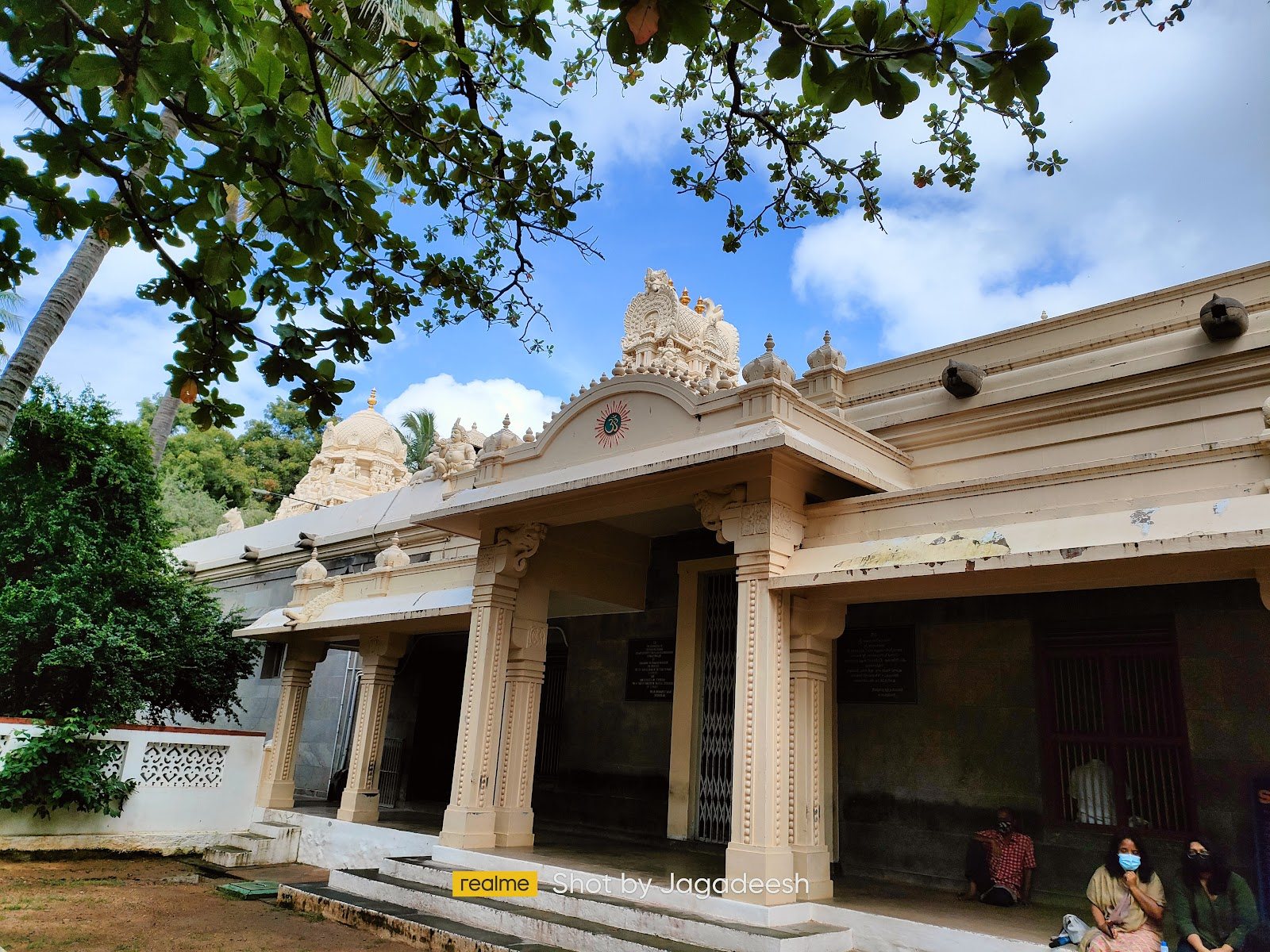
The ashram property opens from Chengam Road into shaded courtyards framed by mature trees, stone pillars, and simple whitewashed structures. The architecture is straightforward and functional, designed to keep interiors cool in the heat of the plains.
Key spaces you will encounter during your walk around the grounds include:
- The Samadhi Hall: This spacious hall contains the samadhi shrine of Sri Ramana Maharshi, as well as the adjoining Mathrubhuteswara shrine dedicated to Lord Shiva, constructed directly over the samadhi of his mother.
- The Old Hall: The small, historic room where the Maharshi sat, slept, and received visitors for decades. It is preserved as a dedicated space for silent meditation.
- The New Hall: A large stone hall that houses a life-size carved stone statue of Sri Ramana Maharshi, often used by visitors for quiet sitting.
- Ashram Library: A rich collection of spiritual, philosophical, and biographical literature printed in diverse global languages.
- The Bookstore: A place near the main gate where you can purchase ashram publications, recorded chants, and translated dialogues of the sage.
Behind the main buildings, small stone paths lead directly to the lower slopes of Mount Arunachala. These trails connect the ashram to walking paths used by residents and pilgrims for generations.
How a visit works during the day
Visiting the ashram is unhurried and straightforward. Entry is completely free and open to all people. The outer gates open at 5:30 AM and close in the evening at 8:30 PM.
The primary shrines, including the Samadhi Hall and the Mother’s Shrine, close during the middle of the day between 11:00 AM and 2:00 PM. If you arrive around noon, you will still be able to walk through the leafy courtyards, but you will need to wait until 2:00 PM to step inside the main interior shrines.
When you arrive, leave your footwear at the designated counter near the front gate. Step quietly into the courtyards and wash your feet at the outdoor taps if you like. You can enter the Samadhi Hall to watch the daily rituals, sit on the cool stone floor, or slip into the Old Hall for silent meditation. Nobody will pressure you to participate in rituals or make donations. You sit for as long as you wish, absorbed in the quiet atmosphere.
Ashram etiquette and what to wear
Because this is an active place of spiritual discipline and veneration, respectful behaviour is essential. Both men and women should wear clothing that covers the shoulders and extends well below the knees. Loose cotton trousers, long skirts, kurtas, or salwar kameez are suitable choices. Shorts, sleeveless tops, and revealing garments are not allowed.
Shoes and sandals must be taken off before walking beyond the entrance boundary. Use the official footwear stall near the entrance gate to keep your sandals safe.
Silence is the defining characteristic of Sri Ramanasramam. Turn your mobile phone completely off, or place it on silent before walking through the gates. Photography and video recording are strictly prohibited inside all shrines and meditation halls. In the Old Hall, visitors maintain complete silence; conversations should be kept to a low whisper even in open courtyards.
Local tip: Slip-on sandals that are easy to step out of make visiting the ashram much simpler, as you will be barefoot throughout your stay on the grounds.
Best time to go and how long to stay
Tiruvannamalai can get very warm during the middle of the day, particularly from March through June. The coolest and most peaceful hours to visit are between 5:30 AM and 8:30 AM, or in the late afternoon from 4:30 PM until nightfall. The morning air at the base of Arunachala is often crisp, and the stone floors remain comfortably cool.
If your goal is simply to walk through the grounds, visit the bookshop, and sit for a short time in the Old Hall, plan for about two hours. If you wish to read in the library or hike up the hill path toward the caves, allow half a day.
The ashram library maintains specific operating hours distinct from the main gates. You can plan your research or reading around its schedule:
| Session | Library Timings |
|---|---|
| Morning Session | 8:30 AM to 11:00 AM |
| Afternoon Session | 2:00 PM to 5:00 PM |
Major festivals draw substantial numbers of people. Key annual observances include Sri Ramana Jayanthi (the Maharshi’s birth anniversary in December or January), Sri Ramana Aradhana (his mahasamadhi anniversary in April or May), and Mahapooja for his mother. The town also becomes very busy during Karthigai Deepam, Maha Shivaratri, and Navaratri.
Getting there from Pondicherry and staying nearby
Tiruvannamalai sits roughly 100 km west of Pondicherry. By private taxi or hired car, the drive takes about 2.5 to 3 hours, depending on traffic along the national highway. Regular state buses also connect Pondicherry bus stand with Tiruvannamalai throughout the day, offering an affordable way to reach the town.
The ashram itself is situated along Chengam Road, approximately 2 km south of the Tiruvannamalai town centre and about 3 km from the Tiruvannamalai Railway Station. Auto-rickshaws are readily available at the bus stand and railway station to bring you directly to the entrance gate.
If you plan to stay overnight to experience the early morning meditation, numerous simple guesthouses, lodges, and small hotels line Chengam Road within easy walking distance of the ashram gates. Booking ahead is wise during full moon nights and festival periods.
Places to see around the ashram
A visit to Sri Ramanasramam easily fits alongside several other significant landmarks in and around Tiruvannamalai:
- Virupaksha Cave and Skandashram: Located on the slopes of Arunachala, these peaceful caves are where Sri Ramana Maharshi lived and meditated before descending to the plains. A walking path leads up from behind the ashram.
- Arunachaleswarar Temple: One of the largest and most ancient Shiva temples in India, located roughly 2 km away in the centre of town, featuring towering gopurams and historic pillared halls.
- Sri Seshadri Swamigal Ashram: Located just a short stroll away along Chengam Road, commemorating another revered contemporary saint of Tiruvannamalai.
- The Girivalam Path: The 14 km circumambulation road circling the base of Mount Arunachala, walked by thousands of pilgrims every month, especially during the full moon.
Along Chengam Road outside the gates, you will find casual vegetarian eateries and small cafes serving south Indian filter coffee, herbal teas, and simple thali meals suited to travellers.
What recent visitors say
A quick, honest snapshot from recent Google reviews, so you know what to expect before you go.
What people loved
★★★★★ Prabhakar · in the last week
“Very peaceful and calm,devine location..one must not miss this while in Thiruvannamalai”
★★★★★ Mani · 2 months ago
“This place is just bliss. Everything is peaceful. Security guards show placards of be silent 🤐. So be quite don’t talk much. They do time to time activities inside the ashram. You can medidate inside the prayer halls. You can realise…”
★★★★★ Naresh · 3 months ago
“The majestic Annamalai Hill is considered by millions of devotees to be the physical manifestation of Lord Shiva, embodying the Agni or fire element of the cosmos. Pilgrims from across the globe gather here to practice Girivalam, a…”
Reviews via Google Maps. Opinions are those of their authors.
Frequently asked questions
Can non-Hindus visit Sri Ramanasramam?
Yes. Sri Ramanasramam is open to people of all faiths, backgrounds, and nationalities. Anyone seeking quiet contemplation or interested in the teachings of Sri Ramana Maharshi is welcome to enter.
Is there an entry fee for Sri Ramanasramam?
No, entry to the ashram is entirely free. There are no tickets or mandatory charges for walking through the grounds, entering the halls, or using the footwear stall.
Can I take photographs inside the meditation halls?
No, photography and video recording are strictly prohibited inside all shrines and meditation halls. You must also silence your phone completely while on the ashram premises to preserve the quiet environment.
What should I wear when visiting the ashram?
You should wear modest, traditional clothing covering both your shoulders and knees. Shorts, sleeveless tops, and revealing clothing are not permitted inside the gates.
Find it
Address: Chengam Road, 63F4+GMH, NH 66, Thamarai Nagar, Tiruvannamalai, Tamil Nadu 606603, India
You might also like
- Where to stay in Pondicherry
- Churches, temples, mosques and ashrams in Pondicherry
- Saneeswarar Temple
- Sri Aurobindo Ashram
- Sacred Heart of Jesus Church
- Things to do in Pondicherry
- Annamalaiyar Temple in Tiruvannamalai: A Visitor Guide
- Visiting Azhagar Temple: A Travel and Pilgrim Guide
- Visiting Parthasarathy Temple in Triplicane Chennai
- Tirupparankundram Murugan Temple: Visiting Guide