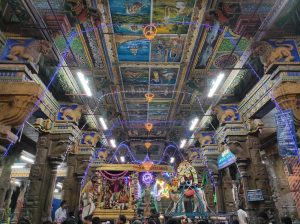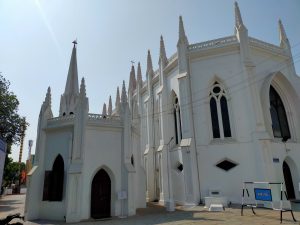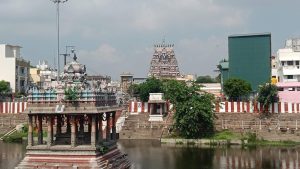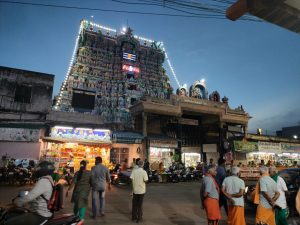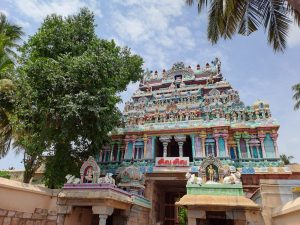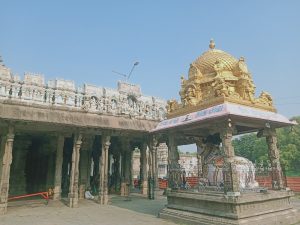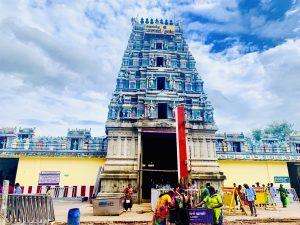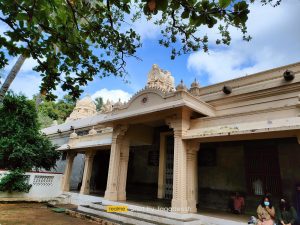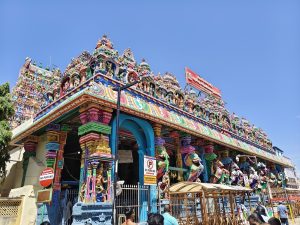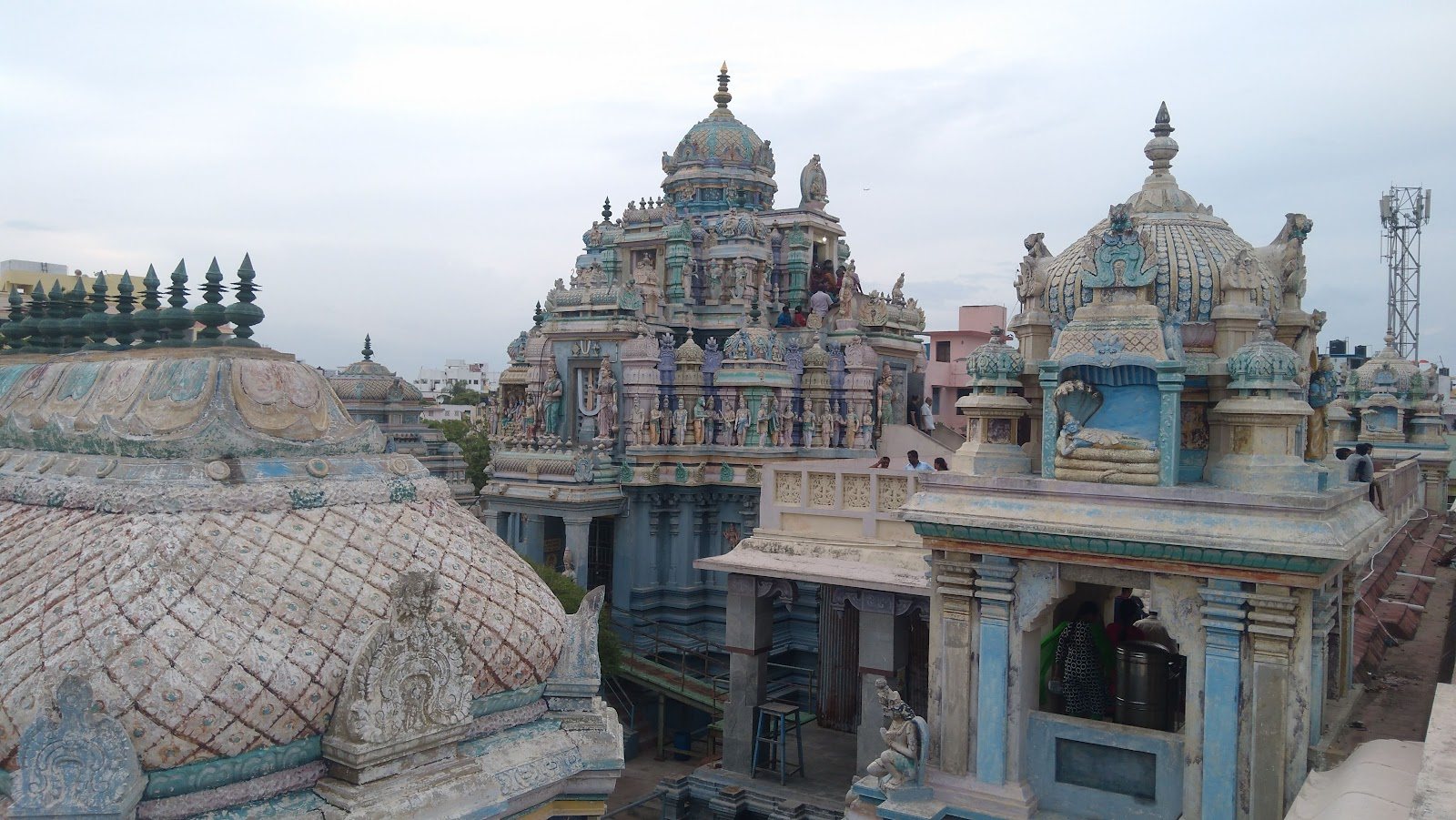
Standing close to the edge of the sea in Besant Nagar, the Shri Ashtalakshmi Temple is one of the most distinctive places of worship along the Tamil Nadu coastline. The temple honours the goddess Lakshmi in her eight traditional forms, each representing a different kind of prosperity, from courage and wisdom to material wealth. If you are travelling up from Pondicherry along the East Coast Road, this makes a peaceful and memorable stop before heading into the centre of Chennai.
Unlike traditional single-level shrines, the building rises in several storeys against the open sky. You hear the rhythmic crash of the surf while walking through the cool stone corridors, and the smell of camphor and sea breeze mingles as you climb from one tier to the next. It is an active parish temple where local families gather daily for morning and evening prayers.
At a glance
| Best time of day | Early morning around 7:00 AM or late afternoon at 4:30 PM |
|---|---|
| Allow | 45 to 75 minutes |
| Dress | Modest clothing covering shoulders and knees; traditional attire recommended |
| Photography | Strictly prohibited inside shrines and worship areas |
| From Pondicherry | roughly 145 km by road, about 3 to 3.5 hours |
History and Spiritual Meaning
The temple owes its inception to the guidance of Sri Chandrashekarendra Saraswati Swamigal, widely remembered as the Maha Periyava of the Kanchi Mutt. The construction was spearheaded by the scholar and devotee Sri Mukkur Srinivasa Varadhachariar. Workers laid the foundation stone in January 1974, and the grand consecration, known as the Kumbhabhishekam, took place on April 5, 1976.
What sets this sanctuary apart across South India is its sole dedication to the eight forms of Goddess Lakshmi, known together as the Ashtalakshmi. While Lakshmi is customarily honoured as a consort alongside Vishnu in larger complexes, here her individual manifestations receive dedicated worship. Each form personifies a distinct blessing necessary for human life: Adi Lakshmi for primordial grace, Dhanya Lakshmi for agricultural produce, Dhairya Lakshmi for patience and courage, Gaja Lakshmi for royal power, Santana Lakshmi for offspring, Vijaya Lakshmi for victory, Vidya Lakshmi for knowledge, and Dhana Lakshmi for material prosperity.
Architecture and What You Will See
The structural design takes inspiration from the ancient multi-tiered temple of Sundara Varadaraja Perumal located in Uthiramerur. Built in a contemporary Dravidian style, the complex rises across four tiers and nine sanctums. The architects engineered the layout so that worshippers can move through every level and complete a full circumambulation of each shrine without ever stepping directly over the roof of another sanctum below.
| Level | Presiding Deities |
|---|---|
| Level 1 (Ground) | Adi Lakshmi, Dhanya Lakshmi, and Dhairya Lakshmi |
| Level 2 | The principal sanctum housing Mahavishnu and Mahalakshmi |
| Level 3 | Santana Lakshmi, Vijaya Lakshmi, Vidya Lakshmi, and Gaja Lakshmi |
| Level 4 (Top) | Dhana Lakshmi |
As you climb the external stairs to the upper levels, you catch clear views of the Bay of Bengal spreading out directly behind the rear perimeter. Along with the eight primary shrines, you will also notice smaller secondary shrines dedicated to Lord Ganesha, Hanuman, Guruvayoorappan, and Dhanvantari, the deity of health. Detailed sculptural reliefs depicting the Dashavatara, the ten incarnations of Lord Vishnu, decorate the walls throughout the complex.
How a Visit Works
When you arrive, walk past the flower sellers outside who string fragrant jasmine, marigold, and tulsi garlands. Before entering the outer gate, you must remove your sandals or shoes and leave them at the designated footwear counter. A small token is handed to you in exchange for your shoes.
General admission for darshan is free of charge. If you wish to offer a personal archana, where a priest recites your birth star and family names, you can buy an archana ticket at the temple counter for a nominal fee. You will then join the line that leads through the prescribed path across the tiers.
- Pay respects at the ground-level shrines of Adi, Dhanya, and Dhairya Lakshmi.
- Take the stairs up to the second level to see the main sanctum of Mahavishnu and Mahalakshmi.
- Ascend to the third level to view the four shrines facing the cardinal directions.
- Climb the final steps to the highest sanctum dedicated to Dhana Lakshmi.
- Descend carefully using the exit staircase, taking in the sea breeze from the open landings.
Local tip: Keep your footwear token safe in your pocket, as you will need it to retrieve your shoes after your visit.
Etiquette and What to Wear
Because this is an active and reverent religious sanctuary, visitors should dress modestly. Men traditionally wear a dhoti or kurta paired with trousers, while women generally wear a saree or salwar kameez. Clothing that leaves your shoulders or knees uncovered is not permitted. If you are travelling casually, bring a light shawl or wrap to cover yourself before stepping past the entrance.
Keep mobile phones silenced and placed inside a bag. Taking photos or recording videos inside the inner sanctums and worship halls is strictly prohibited. You may take pictures of the outer tower from the public beach road outside, but inside, keep your focus on the prayers and the surrounding rituals. Move quietly along the narrow stairs, especially when elderly worshippers are ascending.
Best Time to Go and How Long to Stay
The temple doors generally open from 6:30 AM to 12:00 PM, and re-open in the afternoon from 4:00 PM to 9:00 PM. On Fridays, weekends, and regional festival days, the morning session often remains open a little longer, until roughly 1:00 PM. Because the stone steps absorb the coastal sun, coming early in the morning or during the late afternoon is far kinder on bare feet.
Allow roughly an hour for your visit. That gives you ample time to deposit your shoes, walk all four tiers, observe the coastal views, and sit quietly for a few minutes in the open courtyard before heading out. If you visit during major festivals such as Navaratri, Deepavali, or Varalakshmi Vratam, expect larger crowds and extended waiting times as special pujas like the Lakshmi Kubera Homam are performed.
Getting There from Pondicherry
If you are staying in Pondicherry, the journey up to Besant Nagar in south Chennai takes about 3 to 3.5 hours by taxi or private car along the East Coast Road, covering roughly 145 kilometres. The drive itself is direct and scenic, bypassing the heavy congestion of north Chennai since Besant Nagar sits in the southern seaside suburbs.
For travellers arriving from other points in the city, the Thiruvanmiyur and Kasturba Nagar MRTS stations sit roughly 3 to 4 kilometres away. Chennai Central and Egmore rail stations are about 13 to 15 kilometres north, while Chennai International Airport lies roughly 14 to 16 kilometres to the west. If you plan to spend the night, the surrounding Adyar and Thiruvanmiyur neighbourhoods offer pleasant guesthouses and mid-range business hotels.
Nice to Combine With
Because the temple stands at the southern end of Elliot’s Beach, also called Besant Nagar Beach, you can easily combine your temple visit with a peaceful walk along the shoreline. In the morning, fishermen haul in their nets while local residents walk on the hard sand near the water.
- Arupadai Veedu Murugan Temple: Located just down the lane, honouring the six battle camps of Lord Murugan.
- Annai Vailankanni Shrine: A notable Catholic church overlooking the sea, situated a short walk north along the promenade.
- Theosophical Society: Situated about 3 kilometres away in Adyar, famous for its quiet riverfront gardens and ancient banyan tree.
- Arulmigu Marundeeswarar Temple: A celebrated Chola-era Shiva temple located about 2 kilometres south in Thiruvanmiyur.
After your visit, the neighbourhood around 4th Main Road and the beach road has several traditional South Indian cafes where you can enjoy a hot tumbler of filter coffee and a plate of warm idlis.
What recent visitors say
A quick, honest snapshot from recent Google reviews, so you know what to expect before you go.
What people loved
★★★★★ ravisha · 2 months ago
“There is something so peaceful about Shri Ashtalakshmi Temple that words can’t truly express. The divine atmosphere, beautiful architecture, and serene surroundings make it a place where you instantly feel calm and connected. It’s a truly…”
★★★★★ Manjunath · 3 months ago
“This temple is one of the beautiful and colourful Temple established facing sea side. The temple is quite cool and calm. The sculpture of this astalaxmi temple very good. The temple will be closed between 12 pm to 4 pm . There is a pay and…”
★★★★★ Sathya · 3 months ago
“One of the beautiful temples I have visited so far in Chennai. Nearby beach, makes the place more beautiful. The temple is so unique, having stairs to go to top to see lakshmi gods. So aesthetic and beautifully sculptured!!”
Reviews via Google Maps. Opinions are those of their authors.
Frequently asked questions
Is there an entry fee at Shri Ashtalakshmi Temple?
General entry for darshan is free for all visitors. If you would like the priests to perform an archana or specific ritual on your behalf, a nominal fee is charged at the temple office.
Can non-Hindus enter the temple?
Yes, visitors of all backgrounds are welcome to enter, provided they dress modestly, remove their footwear, and maintain quiet respect for ongoing worship rituals.
Are there elevators or ramps for the upper tiers?
The temple does not have an elevator. Reaching the shrines on the upper levels requires climbing narrow stone staircases, so visitors with mobility issues may find it easier to stay on the ground level.
What festivals are most important here?
The temple celebrates Navaratri with daily decorative alankarams, along with Varalakshmi Vratam and Deepavali. Early morning Dhanur Masa pujas also take place during the Margazhi month from mid-December to mid-January.
Find it
Address: Beach Rd, Kalakshetra Colony, Besant Nagar, Chennai, Tamil Nadu 600090, India
You might also like
- Where to stay in Pondicherry
- Churches, temples, mosques and ashrams in Pondicherry
- Saneeswarar Temple
- Sri Aurobindo Ashram
- Sacred Heart of Jesus Church
- Things to do in Pondicherry
- Visiting Parthasarathy Temple in Triplicane Chennai
- Visiting Sri Parthasarathyswamy Temple in Chennai
- Visiting Santhome Cathedral Basilica in Chennai: A Guide