Airavatesvara Temple in Dharasuram is one of the finest architectural treasures in southern India. Built during the height of the imperial Chola dynasty, this quiet complex offers a close-up look at stone carving of extraordinary delicacy. It feels far more intimate than the colossal temples at Thanjavur or Gangaikonda Cholapuram, giving you space to slow down and study the work of master builders.
If you are travelling inland from Pondicherry, Dharasuram makes a wonderful cultural stop. The temple sits on the edge of Kumbakonam, an area known for brass craft, fine weavers, and filter coffee. Here is practical advice on how to plan your visit, what to look for on the stone walls, and how to arrive with ease.
At a glance
| Best time of day | Early morning or late afternoon for cool stone and soft light |
|---|---|
| Allow | 1.5 to 2 hours |
| Dress | Modest clothing covering shoulders and knees; traditional attire preferred inside |
| Photography | Allowed on grounds and pillared halls; forbidden in the inner sanctum |
| From Pondicherry | roughly 135 km by road, about 3.5 to 4 hours |
The story and significance of Dharasuram
Airavatesvara Temple was built during the twelfth century CE by the Chola Emperor Rajaraja II. It stands as an important piece of late Chola history, reflecting an era when builders focused on refined, jewel-like decoration rather than sheer scale. Together with the Brihadisvara Temples at Thanjavur and Gangaikonda Cholapuram, it forms part of the Great Living Chola Temples, recognized worldwide as a UNESCO World Heritage Site.
The sanctuary is dedicated to Lord Shiva, worshipped here as Airavatesvara. Local lore connects the site to Airavata, the sacred white elephant of Indra. According to the legend, the elephant lost its pure color because of a sage’s curse and regained its spotless complexion only after bathing in the temple tank, known as Yama Theertham, and offering prayers to Shiva. Another tradition recalls that Yama, the god of death, came here to seek relief from a terrible burning affliction and found his cure before the deity.
Today, the complex is preserved as a monument of national importance under the Archaeological Survey of India (ASI). While it is maintained with conservation care, it remains an active place of worship where daily rituals continue, blending historical preservation with living Tamil devotion.
Stone carvings and architectural details to notice
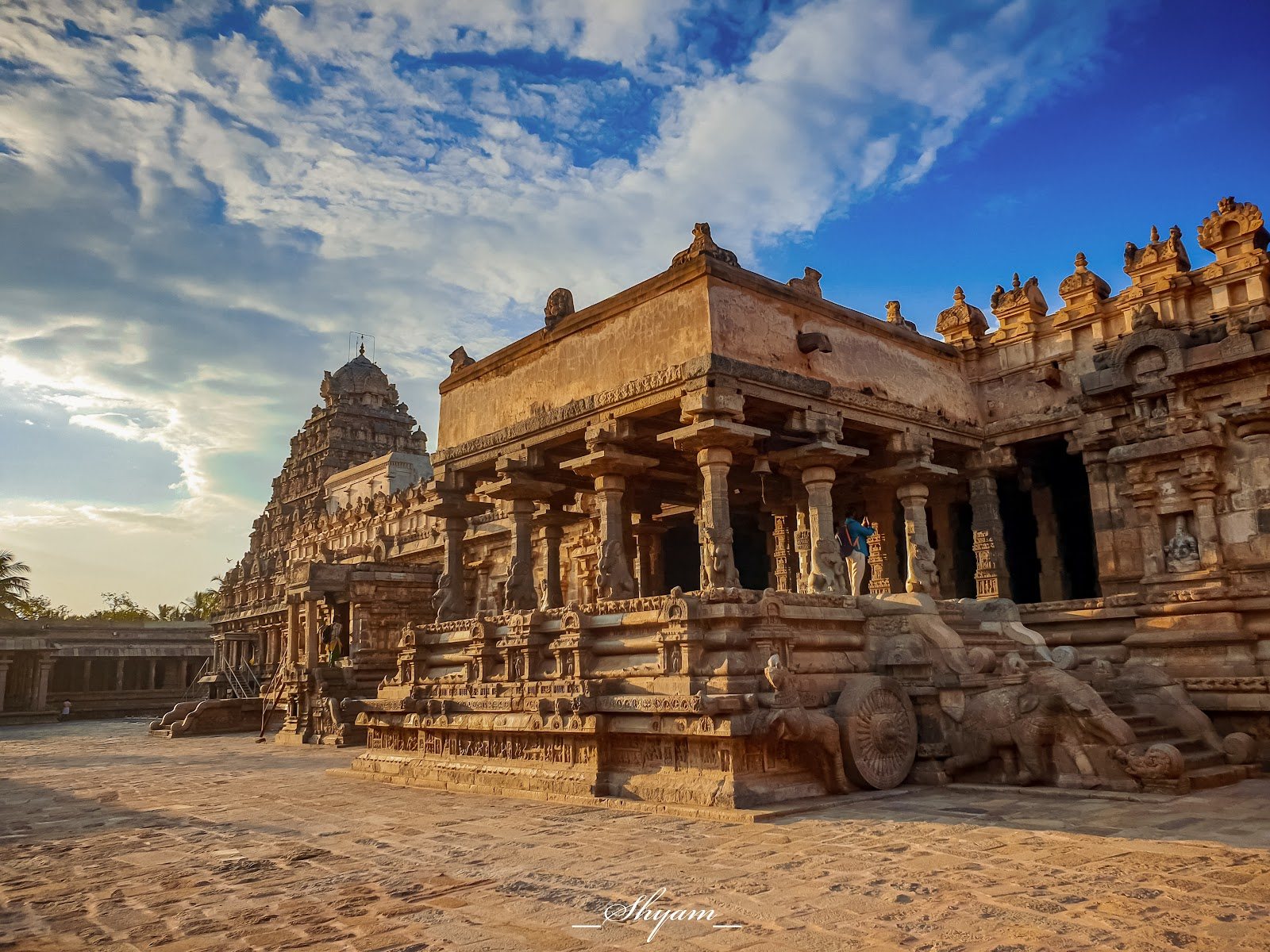
As you walk toward the main entrance, you will notice the balance of the late Chola Dravidian architecture. The temple does not overwhelm you with height, but rather draws your eyes to miniature friezes, elegant pillars, and sharp relief work carved directly into hard stone.
The centerpiece of the outer structure is the Agra Mandapa, the front hall. The entire porch is carved to resemble a grand celestial chariot, complete with spoke-detailed stone wheels and pulled by galloping horses and elephants. Walking around its plinth reveals bands of friezes that capture court life, musicians, and mythical creatures with astonishing precision.
- The musical steps: Near the balipeetam sits a flight of seven stone steps designed to produce distinct musical notes when tapped. To protect these ancient stones from erosion and wear, the steps are kept behind a protective fence, but you can still view their clean geometry.
- Dance poses: The basement mouldings and pillar bases feature miniature reliefs illustrating Bharatanatyam karanas. Students of classical dance often come here specifically to study these carved postures.
- Shaivite legends: Along the walls, you will find tiny, detailed panels depicting episodes from the lives of the 63 Nayanars, the poet-saints of Tamil Shaivism.
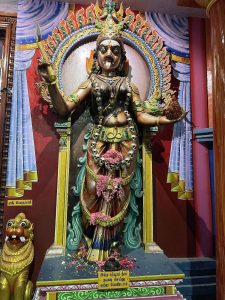
- Periya Nayaki Amman Shrine: Situated just adjacent to the central enclosure, this dedicated shrine honouring the goddess shares the same fine artistic style and offers a peaceful place to sit.
Local tip: Look closely at the lower registers of the chariot hall. The stone carvers added humorous, lively domestic details alongside sacred figures, showing that eleventh and twelfth-century sculptors had a playful eye for human nature.
How a visit works in practice
A visit to Dharasuram is straightforward and calm. Because the site is cared for by the Archaeological Survey of India, the surrounding lawns and stone pathways are kept clean and orderly. Entry to the monument is free of charge for all visitors.
You will leave your footwear at the designated stands near the entrance gate before stepping onto the stone pavings. From there, you are free to explore the grassy borders, the outer corridor, and the chariot mandapa. Non-Hindu visitors are welcome throughout the monument complex and pillared halls. As you approach the inner sanctum where the primary lingam is enshrined, local priests conduct traditional arati and puja at set times during the day. You are welcome to observe quietly from the hall.
The temple sees larger gatherings during sacred occasions. If you travel during Maha Shivaratri, Arudra Darisanam, or the monthly Pradosham observances, you will encounter local families coming to pray, listen to chants, and participate in special ablutions.
Etiquette, dress code, and photography rules
Because Airavatesvara is a functioning place of worship as well as a protected historic structure, thoughtful behavior is appreciated by the temple caretakers and priests.
- Dress code: Wear modest clothing that covers both shoulders and knees. Loose cotton trousers, long skirts, or salwar kameez are practical choices in the heat. Traditional Indian dress, such as a dhoti or saree, is preferred if you intend to go near the inner sanctum.
- Footwear: Shoes, sandals, and socks should be removed before entering the paved stone courtyard. Leave them at the storage counter outside the main entrance.
- Photography: Taking pictures is permitted across the open grounds, courtyards, and within the pillared mandapa. However, photography is strictly prohibited inside the inner sanctum.
- Quiet atmosphere: Keep your voice low while inside the halls, and step aside gently if devotees are offering prayers or walking their rounds around the shrines.
Best time to visit and how long to plan for
Like most major temples across Tamil Nadu, Airavatesvara Temple observes a midday closure. It is generally open daily from 6:00 AM to 12:30 PM, and reopens in the afternoon from 4:00 PM to 8:00 PM. These hours can adjust slightly on festival days.
The stone courtyard warms up considerably under direct sunlight. Arriving right at 6:30 AM or around 4:30 PM allows you to walk barefoot on the stone slabs comfortably and view the carvings when the sunlight falls across the relief work at a low angle. Plan to spend about 1.5 to 2 hours here. That gives you plenty of time to stroll the perimeter, inspect the chariot details, and sit quietly in the shaded colonnades.
Getting to Dharasuram from Pondicherry and where to stay
Dharasuram is located roughly 135 km southwest of Pondicherry. Driving by private car or taxi takes about 3.5 to 4 hours, taking you through rural landscapes, sugarcane fields, and towns along the Cauvery delta. If you prefer public transit, regular buses run from Pondicherry to Kumbakonam, which sits just 4 km away from the temple gates.
Kumbakonam Railway Station is also roughly 4 km from the temple, and Dharasuram itself has a small local railway halt for passenger trains. For flights, Tiruchirappalli International Airport is the nearest air hub, situated approximately 90 km to the west.
While it is possible to visit on a long day excursion from Pondicherry, staying overnight in Kumbakonam is far more relaxing. Kumbakonam has comfortable hotels, heritage stays, and traditional vegetarian messes. From Kumbakonam town, you can reach Dharasuram by auto-rickshaw in about ten minutes.
Other places to see in the neighbourhood
The fertile delta around Kumbakonam is home to some of South India’s greatest temple architecture. You can easily link several major sights into a single day of travel.
- Adi Kumbeswarar Temple: Located about 4 km away in the center of Kumbakonam, this grand Shiva temple has tall gopurams and lively bazaar streets outside.
- Sarangapani Temple: Just 4 km away, known for its towering entrance tower and chariot-styled inner shrine dedicated to Vishnu.
- Swamimalai Murugan Temple: Roughly 5 km from Dharasuram, set atop an artificial hillock and celebrated as one of the six holy abodes of Murugan.
- Brihadisvara Temple, Thanjavur: Located approximately 40 km away, the grandest of the Chola imperial projects with its massive stone vimana.
- Gangaikonda Cholapuram Temple: Located about 35 km to the north, offering a sweeping courtyard and elegant sculpture created by Rajendra Chola I.
Between visits, stop at a local Kumbakonam restaurant for hot idlis, sambar, and a cup of freshly brewed degree coffee served in traditional brass dabarah cups.
What recent visitors say
A quick, honest snapshot from recent Google reviews, so you know what to expect before you go.
What people loved
★★★★★ M · a month ago
“Magnificent sculpture work by ancestors from the Chola period. It has been recognized as a UNESCO World Heritage Site. Wonderful Amazing and Unbelievable Temple. A beautiful Shiva temple with its moments. Chola Raja’s ideology also…”
★★★★★ Maddu · 2 months ago
“Airavatesvara Temple is a very peaceful and beautiful place. There are many trees around the temple, and you can sit outside and relax. Darshan is available only during temple timings, so plan your visit accordingly. The famous musical…”
★★★★★ Anvesh · 4 months ago
“The Airavatesvara Temple at Darasuram is a jaw-dropping testament to Chola craftsmanship. Built by Rajaraja Chola II, it stands out for its incredibly detailed miniature sculptures rather than massive scale. Walking through the…”
Reviews via Google Maps. Opinions are those of their authors.
Frequently asked questions
Is there an entry ticket for Airavatesvara Temple?
No, entry to the temple is completely free. You may choose to leave a small tip of a few rupees at the shoe counter outside.
Can non-Hindu travellers enter the temple?
Yes, visitors of all faiths are welcome throughout the monument grounds, courtyard, and pillared halls. As with all living temples, maintain quiet respect near the inner sanctum.
Can visitors play the musical steps?
No, the steps are fenced off to protect the stone from physical wear and vandalism. You can view them clearly from a short distance.
Is photography permitted inside?
Photography is allowed on the open lawns, courtyards, and outer pillared mandapas. It is strictly prohibited inside the inner sanctum.
Find it
Address: Gurunathan Pillai Colony, Dharasuram, Tamil Nadu 612702, India
You might also like
- Where to stay in Pondicherry
- Churches, temples, mosques and ashrams in Pondicherry
- Saneeswarar Temple
- Sri Aurobindo Ashram
- Sacred Heart of Jesus Church
- Things to do in Pondicherry
- Visiting Solaimalai Murugan Temple in Alagar Hills
- Visiting the Sai Baba Temple Mylapore in Chennai
- Visiting the Kailasanatha Temple in Kanchipuram