Kalikambal Temple stands along Thambu Chetty Street in Chennai, providing a calm and deeply revered place of worship in the historic George Town district. Dedicated to Goddess Kaligambal and Lord Kamadeswarar, this ancient shrine brings together centuries of regional history, community care, and daily devotional life.
If you are travelling north from Pondicherry or spending time in Chennai before continuing down the Coromandel coast, a morning spent walking through these stone halls offers a grounded, authentic look at city faith away from the typical tourist routes.
At a glance
| Best time of day | Early morning between 6:00 AM and 8:30 AM |
|---|---|
| Allow | 45 to 60 minutes |
| Dress | Modest traditional attire covering shoulders and knees |
| Photography | Prohibited inside shrines and the inner sanctum |
| From Pondicherry | roughly 150 km by road, about 3.5 to 4 hours |
Why this place matters
Kalikambal Temple has a long and documented journey tied closely to the founding of modern Chennai. The temple originally stood right along the seashore, on the precise grounds where Fort St. George was later built. When the British East India Company began constructing their fortification, the shrine was relocated to its current inland position on 1 March 1640 CE. Work on the new complex continued steadily through 1678.
Over the centuries, the deity came to be known affectionately as Kottaiamman, meaning fort goddess, in memory of its original coastal home, as well as Chennamman, derived from the word for holy crimson. According to local religious accounts, the goddess was once worshipped in a fierce mood until the philosopher Adi Shankara consecrated the sacred Ardhameru and Sri Chakra here, calming the presence into a peaceful shanta swaroopa form identified with Goddess Kamakshi.
Several notable historical figures walked these stone corridors. The founder of the Maratha Empire, Chhatrapati Shivaji, came here in person to offer worship on 3 October 1677. In the early twentieth century, the celebrated Tamil nationalist poet Subramania Bharati was a regular visitor to the sanctum. Later, in 1952, the well-known Tamil devotional hymn Ullam Uruguthaiya was conceived and composed right on the temple premises by Andavan Picchi.
Today, the complex remains under the hereditary stewardship of the Viswakarma community under the guidance of the Madras High Court, with a five-member board elected by men of that community to oversee its daily administration and ongoing upkeep.
What you will see
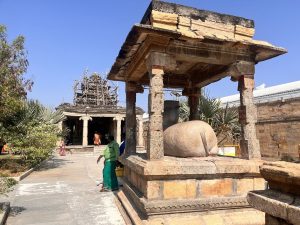
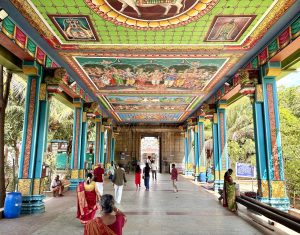
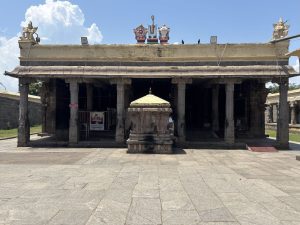
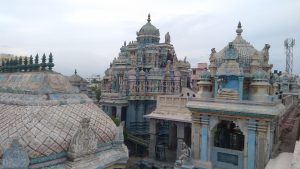
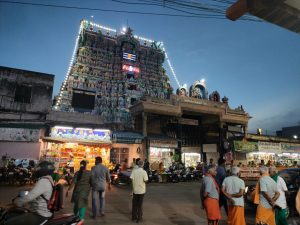
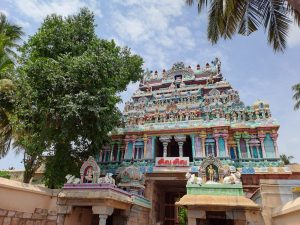
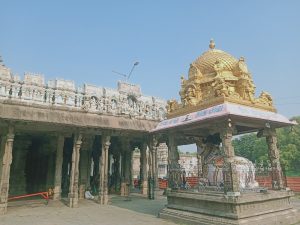
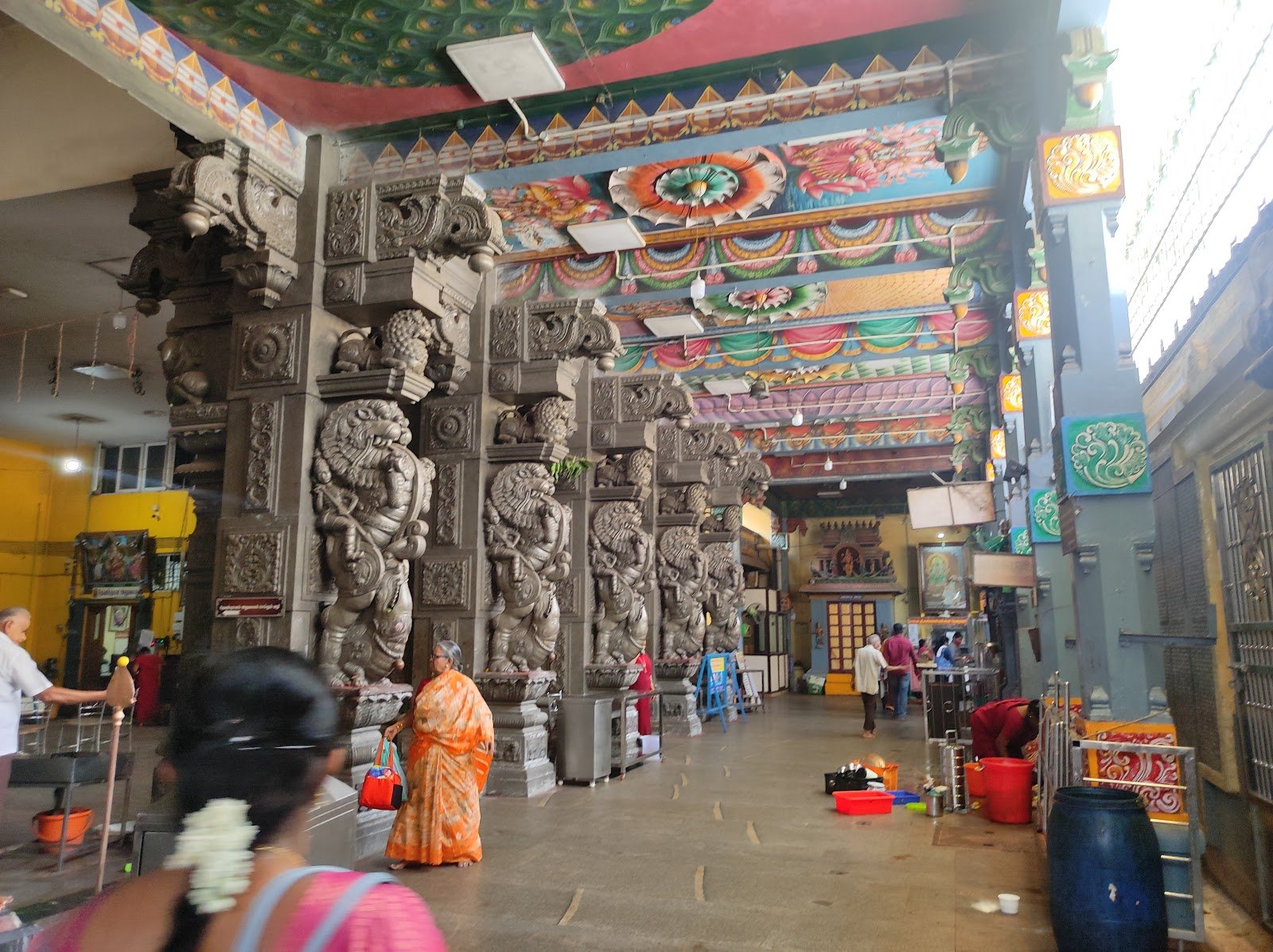
The temple exhibits classic Dravidian stone construction with carved granite pillars, raised thresholds, and decorative mandapams. At the entrance rises a multi-tiered Rajagopuram measuring ten metres high. Construction of this tower began in January 1976 and reached completion in January 1983, with further structural expansion completed in 2014 to accommodate the growing congregation.
The primary deity, Sri Kalikambal, is unusual in that her sanctum faces west rather than east. Temple lore recounts that sages and celestial figures such as Vyasa, Agastya, Aangeerasa, Pulasthya, and Varuna worshipped at this altar. At the base of the main idol rests the form of Thirusiran, also known as Sri Vishwarupan. The temple procession deity, known as Periyanayaki, stands upright upon an ornate chariot flanked by Mahalakshmi and Saraswati.
As you wander through the interior corridors, you will pass numerous independent shrines dedicated to other divinities. These include Shiddi Vinayakar, Shiddi-Bhuddi Vinayakar, Agora Veerabadhra, Mahakali, Vadakathirkama Murugan, Virat Vishwa Parabrahma, Gayatri, Durga, Dakshinamurthy, and Pratyangira, alongside dedicated spaces for Kubera and the Navagrahas.
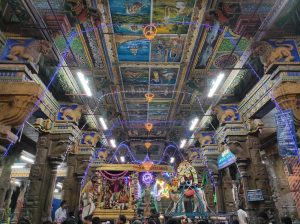
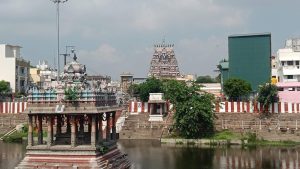
One especially distinct artistic feature is the Kinnither, also known as the Sri Chakra Vimanam. This ritual chariot is adorned with gleaming brass and metal cymbals. Look also for the temple sthla vriksha, a sacred mango tree, while the traditional sthla tirtha associated with the shrine remains the sea itself.
How a visit works
A visit begins outside on Thambu Chetty Street, a narrow commercial road filled with local trade, transport, and banking offices. Before walking into the gopuram gateway, you must deposit your sandals or shoes at the designated footwear stand outside the main doors.
Inside, the atmosphere shifts into a sheltered sequence of stone courtyards. You join the queue for general darshan, moving at a measured pace toward the western-facing sanctum. Along the way, priests perform traditional rituals, waving brass lamps, offering sacred ash and vermilion, and chanting hymns.
Special worship services and festivals take place throughout the year, changing the daily pace inside the complex. The following calendar outlines when the primary celebrations occur according to the traditional Tamil calendar:
| Tamil Month | Festival or Observance | Ritual Highlights |
|---|---|---|
| Chitthirai | Chithra Pournami | Full-moon day prayers and special ablutions |
| Vaikasi | Vaikasi Brahmotsavam | Ten-day annual car festival and major temple rituals |
| Aani | Vasantha Urchavam | Summer ritual services honoring the deities |
| Aadi | Aadi Pooram and Thotti Unjal | Swing festival celebrated across nine consecutive Fridays |
| Aippasi | Annabishekam | Full-moon cooked rice offering covering the main lingam |
| Karthikai | Karthikai Deepam | Special lighting of oil lamps and Monday rituals |
| Maargali | Dhanur Pooja | Early morning winter prayers and devotional songs |
| Maasi | Theerthavaari | Ritual holy bath procession conducted at the seashore |
Local tip: Visit on a quiet weekday morning between 7:00 AM and 8:30 AM to avoid the heavy queues that form during evening pradakshinam and festival days.
Etiquette and what to wear
This is an active place of daily worship, and visitors should behave with genuine quiet and discretion. Modest clothing is strictly expected of everyone who enters. Men should wear dhotis, traditional pyjamas, or formal trousers paired with shirts. Women should wear sarees, salwar suits, or loose Indian garments that cover the shoulders, chest, and knees. Shorts, short skirts, and sleeveless tops are not accepted.
Footwear must remain outside. Do not bring leather bags or items close to the sanctum if possible, and silence your mobile phone before passing through the outer gateway. Photography is strictly forbidden within the inner mandapams, shrines, and central sanctum.
Practicing Hindus may queue for full darshan in front of the sanctum sanctorum. Non-Hindu visitors are welcome to walk respectfully through the outer pillared hallways and open courtyards to view the architecture, but access directly inside the primary inner shrine is reserved for practicing devotees.
Best time to go and how long to stay
The temple typically opens each morning around 6:00 AM and closes for the afternoon between 12:00 PM and 1:00 PM. It reopens for evening worship around 4:30 PM and remains open until roughly 8:30 PM or 9:00 PM. These hours can extend significantly during auspicious days, full-moon evenings, and annual temple observances.
Cooler morning hours offer the best light and the calmest pace. You will need about 45 to 60 minutes for a complete, unhurried walk through the mandapams and subsidiary shrines.
If you wish to witness major devotional gatherings, consider timing your trip around the ten-day Vaikasi Brahmotsavam in May or June, or the nine nights of Navaratri in September or October, when the shrines receive elaborate floral alankarams and extended music recitals.
Getting there from Pondicherry and where to stay nearby
Kalikambal Temple sits in the Mannadi neighborhood of George Town in northern Chennai. If you are starting from Pondicherry, the journey covers roughly 150 km northward via the East Coast Road (ECR) or Grand Southern Trunk Road (GST Road). By private car or taxi, the drive takes about 3.5 to 4 hours depending on coastal traffic and Chennai city congestion.
For public transit users arriving in Chennai, the location is very convenient. Chennai Beach Station is roughly 1 km away, while Puratchi Thalaivar Dr. M.G. Ramachandran Central Railway Station sits about 2.5 km southwest. High Court Metro Station provides clean and quick rail transit right into the Parry’s Corner district. If you are arriving directly by air, Chennai International Airport is located roughly 21 to 25 km to the southwest.
When choosing accommodation, staying in central Chennai neighborhoods like Egmore, Mount Road, or Mylapore provides a comfortable base with easy taxi or metro access up into George Town. If you prefer to stay closer to old colonial quarters, business hotels around Parry’s Corner and Chennai Central provide direct walking or auto-rickshaw access to Thambu Chetty Street.
Nice to combine with
George Town is packed with colonial architecture, trading bazaars, and long-standing religious landmarks, making it simple to spend half a day exploring on foot.
- Fort St. George and Fort Museum: Located just south of the temple, this is the historic military settlement whose construction in 1640 prompted the relocation of the temple to Thambu Chetty Street.
- Armenian Church: Located a short walk away on Armenian Street, this serene eighteenth-century heritage site features peaceful grounds and a famous belfry housing six massive bells.
- Madras High Court: One of the finest examples of Indo-Saracenic architecture in India, situated right across from Parry’s Corner.
- Marina Beach: A ten-minute drive south along Rajaji Salai brings you to the broad sands of Chennai’s famous coastal promenade for a refreshing late-afternoon walk.
After completing your temple walk, step into one of the traditional vegetarian mess halls or heritage Udupi restaurants along George Town’s lanes for a hot filter coffee and freshly fried medu vada.
What recent visitors say
A quick, honest snapshot from recent Google reviews, so you know what to expect before you go.
What people loved
★★★★★ Shanmugam · in the last week
“Very Power full Indhu god”
★★★★★ Abhishek · 3 months ago
“The temple carries a deeply fascinating history. Originally located closer to the seashore, it was relocated to Thambu Chetty Street in 1640 to make way for the British East India Company’s construction of Fort St. George. Great historical…”
★★★★★ WandererFromChennai · 4 months ago
“Shri Kaalikaambaal temple is one of my favorite holy shrine in Chennai. I love to spend time here and pray to mighty Goddess Kaalikaambaal. The temple has got 2 entrances. One at Armenian street and one at Thambu Chetty street. It is very…”
What some found difficult
★★★☆☆ karthick · 3 months ago
“Visited on:Saturday Weekend Rush 🚗 Traffic & Parking Warning: Extremely Difficult * **The Streets:** The temple is located in a very narrow, highly congested commercial street in Mannadi. The traffic is continuously busy. * **Four-Wheeler…”
Reviews via Google Maps. Opinions are those of their authors.
Frequently asked questions
Is there an entry fee at Kalikambal Temple?
Entry into the temple for general darshan is completely free. Dedicated queues for special archana or festival services may have nominal ticket charges managed directly at temple counters.
Can non-Hindus enter the temple?
Non-Hindu visitors may walk respectfully through the outer courtyards and admire the Dravidian architecture. However, entry directly into the inner sanctum sanctorum is reserved for practicing Hindus.
What is the history behind the name Kottaiamman?
Kottai means fort in Tamil. Because the temple stood along the seashore where Fort St. George was erected before its 1640 relocation, devotees traditionally called the deity Kottaiamman.
Are cameras and mobile photography allowed inside?
Photography and videography are strictly prohibited inside the inner mandapams and shrines. Please keep phones switched off or silenced inside your bag while touring the premises.
Find it
Address: 212, Thambu Chetty St, near DHL Express Courier, Mannadi, George Town, Chennai, Tamil Nadu 600001, India
You might also like
- Where to stay in Pondicherry
- Churches, temples, mosques and ashrams in Pondicherry
- Saneeswarar Temple
- Sri Aurobindo Ashram
- Sacred Heart of Jesus Church
- Things to do in Pondicherry
- Visiting Parthasarathy Temple in Triplicane Chennai
- Visiting Sri Parthasarathyswamy Temple in Chennai
- Visiting Santhome Cathedral Basilica in Chennai: A Guide
- Visiting Shri Ashtalakshmi Temple in Chennai: A Guide