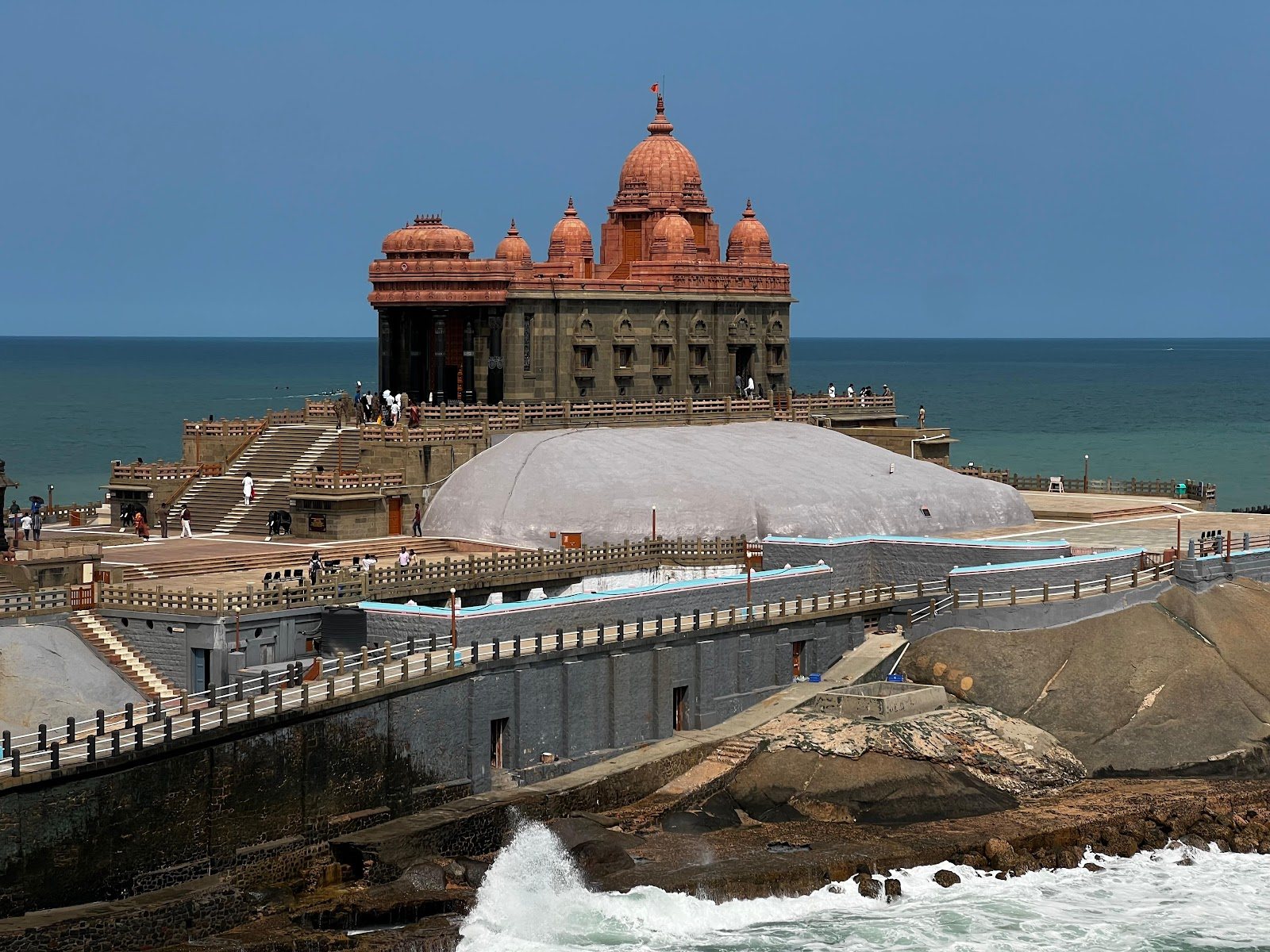
The Vivekananda Rock Memorial rises out of the sea roughly five hundred metres off the mainland shore of Vavathurai in Kanniyakumari. Sitting at the southernmost tip of the Indian mainland, this open rocky outcrop marks the meeting point of the Bay of Bengal, the Arabian Sea, and the Indian Ocean. Reaching it requires a short ferry ride over waters that swell and shift with the wind, giving you an immediate sense of distance from the shore.
If you travel south from Pondicherry to the tip of Tamil Nadu, this memorial is one of the most thoughtful places you can spend an morning. It combines ancient devotion with modern national history, offering broad stone platforms open to the ocean breeze and quiet halls where you can sit and reflect away from the mainland crowds.
At a glance
| Best time of day | Early morning, between 8:00 AM and 10:30 AM |
|---|---|
| Allow | 2 to 3 hours including ferry transit |
| Dress | Modest clothing covering shoulders and knees; socks advised for hot stone |
| Photography | Permitted outside on the decks; strictly forbidden inside shrines |
| From Pondicherry | roughly 580 km by road (about 10 to 11 hours) |
Why this memorial matters
The rocky island has held sacred meaning for many generations. According to ancient regional belief, it was on this very rock that Goddess Kanyakumari, an aspect of Parvathi, performed severe penance on one foot in devotion to Lord Shiva. For centuries, pilgrims knew the protrusion as Shripada Parai, honouring the footprint left behind by the Goddess.
In late December 1892, Swami Vivekananda arrived in Kanniyakumari. Looking out from the beach, he swam across the open water to reach the isolated rock mid-sea. He sat there in uninterrupted meditation for three days and three nights, an experience that led to his well-known resolve to dedicate his life to the spiritual and social uplift of India before he sailed for the Parliament of Religions in Chicago.
Decades later, during Swami Vivekananda’s birth centenary in 1962, plans took shape to build a permanent memorial here. The path was not simple. Local Catholic fishermen had long placed a cross on the outcrop, calling it Kurusu Paarai, using the dry stone to pray and dry their fishing nets. Amid heated regional disputes, the cross was removed at night, and the state government initially placed armed guards on the rock and barred any major building work, permitting only a small memorial tablet in early 1963.
The creation of the present structure was guided almost entirely by Eknath Ranade. Facing political resistance from state and central leaders, Ranade gathered signatures from 323 Members of Parliament across political lines and secured Prime Minister Jawaharlal Nehru’s support. He consulted the Paramacharya of Kanchi Kamakoti Peetham, who helped guide the design. To pay for the massive construction, Ranade launched a nationwide campaign using one-rupee donation folders, inviting everyday citizens from Tamil Nadu to Nagaland to contribute. The completed monument opened to the public in 1970, followed in 1972 by the founding of Vivekananda Kendra, a service mission dedicated to non-monastic social work.
What you will see across the rocks
The memorial consists of two primary stone pavilions constructed from local red and blue granite, blending architectural styles drawn from Pallava, Chola, and classic temple traditions across India. Walking between them, you will notice the balance of heavy, carved masonry resting securely against the harsh ocean elements.
The Shripada Mandapam is the first major pavilion. It is built directly over the sacred rock protrusion that pilgrims honour as the footprint of the Goddess. The interior stays dim and cool, carrying the scent of oil lamps and fresh flowers where visitors pause to pay their respects.
A short flight of steps leads up to the larger Vivekananda Mandapam. Inside this hall, you will find two distinct spaces:
- The Sabha Mandapam: a spacious assembly room holding a life-size bronze statue of Swami Vivekananda in his familiar upright stance.
- The Dhyana Mandapam: an attached meditation hall kept in semi-darkness, centered around an illuminated Om symbol where anyone can sit on the floor in unbroken silence.
Outside the halls, the open granite platforms give you an unhindered perspective of the sea. Looking north, you can see the mainland shore and the colored fishing boats of Vavathurai. Looking east across a narrow channel of water, you will see the colossal stone statue of the Tamil poet-philosopher Thiruvalluvar standing on the adjacent rock outcrop.
How a visit works
Visits begin at the mainland ferry terminal in Kanniyakumari, run by the state-owned Poompuhar Shipping Corporation. You buy your ferry token and monument entrance pass at the counter near the pier. Two queues operate here: a standard general queue and an express queue, which carries a higher fee but cuts your waiting time substantially on busy mornings.
The ferry crossing takes roughly ten minutes. Life jackets are issued as you board, and the boat bobs steadily over the swells before docking at the rock’s sheltered landing stage. Ferry operations rely completely on calm sea conditions; if high waves or strong winds make docking unsafe, services halt without advance notice.
Local tip: Bring a spare pair of thick cotton socks in your bag. You must take off your footwear before stepping onto the mandapam platforms, and the bare granite can turn blisteringly hot under the coastal sun by noon.
Once you step onto the island, staff direct you to free footwear counters where you hand in your shoes. From there, you are free to wander the platforms, walk through the Shripada Mandapam, view the statue in the Sabha Mandapam, and spend as long as you wish sitting inside the quiet meditation hall.
Etiquette and clothing guidelines
The memorial is open to visitors of all religious traditions, backgrounds, and nationalities. Because it houses an active place of worship around the Shripadam and a serious meditation space, the environment demands quiet, respectful behavior throughout your stay.
Dress conservatively. Both men and women should wear clothing that covers the shoulders and extends well past the knees. Sleeveless shirts, short skirts, and beachwear are not permitted on the island.
Photography and mobile phone filming are permitted freely on the outside decks, near the steps, and during the ferry crossing. However, photography is strictly prohibited inside the inner shrines, the statue hall, and the Dhyana Mandapam. Keep your phone silenced, speak in whispers near the mandapams, and follow the directions of the Kendra attendants stationed throughout the halls.
Best time to go and how long to stay
The memorial is generally open daily between 8:00 AM and 4:00 PM. Arriving at the ferry ticket counter around 7:45 AM is the smartest choice. Morning visits reward you with shorter ticket lines, cooler stone beneath your feet, and calmer waters during the boat ride.
Plan for two to three hours in total. This gives you forty-five minutes for the two-way ferry wait and ride, and over an hour to explore the two mandapams, meditate in silence, and watch the waves crash against the rock ledges.
Crowds surge significantly around major occasions. The most notable dates to keep in mind include:
- National Youth Day and Vivekananda Jayanti (January 12), which marks Swami Vivekananda’s birth anniversary.
- Chitra Pournami (the full moon day in April or May).
- Guru Purnima (the full moon day in July).
Getting there from Pondicherry and where to stay
Kanniyakumari sits roughly 580 kilometres southwest of Pondicherry. While it is too far for a day trip, it forms a rewarding southern extension to a Tamil Nadu journey. The easiest route by road runs along National Highway 38 and National Highway 44, passing Villupuram, Tiruchirappalli, and Madurai, which takes about ten to eleven hours by private taxi or bus.
If you prefer rail travel, long-distance trains link Villupuram Junction (about forty kilometres from Pondicherry) directly to Kanniyakumari Railway Station, which terminates roughly one to two kilometres from the ferry pier. For those arriving by air, Trivandrum International Airport in Kerala lies roughly ninety to one hundred kilometres away, from where you can take a taxi south across the state border.
When choosing where to stay, look for hotels and guest houses located within walking distance of the main beach and the ferry jetty. Staying near the shore allows you to walk down for sunrise and reach the ferry gates early before day-tripper buses arrive from neighboring towns.
Nice places to combine with your visit
Because the ferry terminal sits right beside the town center, you can easily combine your visit to the rock memorial with several other historic spots within a few minutes’ walk:
- Thiruvalluvar Statue: perched on the neighboring rock island, accessible via connecting ferry boats when sea conditions allow.
- Bhagavathy Amman Temple: the ancient coastal temple dedicated to Goddess Kanya Kumari, located just a short walk south of the jetty.
- Gandhi Memorial Mandapam: an architectural monument on the seafront designed so that the sun’s rays fall upon the spot where Mahatma Gandhi’s ashes were placed prior to immersion.
- Triveni Sangam: the shoreline bathing ghat where pilgrims gather at sunrise where the three bodies of water meet.
After you step off the afternoon ferry, take a quiet seat at one of the small vegetarian dining messes near the beach for a hot plate of tiffin, crispy dosas, and fresh South Indian filter coffee while the sea wind cools the town.
What recent visitors say
A quick, honest snapshot from recent Google reviews, so you know what to expect before you go.
What people loved
★★★★★ Bharathi · in the last week
“I have mixed opinions about the place as carrying toddlers is not advisable especially when it rains.People travelling in groups will enjoy this place”
★★★★★ S. · a month ago
“Visited Vivekananda Rock Memorial, Kanyakumari – truly divine and peaceful. Exciting ferry ride with stunning ocean views. The silent meditation hall feels very spiritual and calm. Clean, well-maintained monument surrounded by sea…”
★★★★★ Balarama · 2 months ago
“Vivekananda Rock Memorial is a must-visit place in Kanyakumari. It is believed that Swami Vivekananda meditated here in 1892 before starting his spiritual journey. The memorial is peaceful, clean, and offers beautiful views of the sea. The…”
Reviews via Google Maps. Opinions are those of their authors.
Frequently asked questions
Can people of all religions visit the Vivekananda Rock Memorial?
Yes. Visitors of all faiths, backgrounds, and nationalities are welcome throughout the memorial. You only need to follow the basic rules of modest dress, shoe removal, and silence inside the prayer and meditation halls.
How long is the ferry ride to the rock?
The ferry ride across the water takes roughly ten minutes each way. However, you should allow extra time for the boarding lines at both the mainland jetty and the rock.
What happens if the sea is rough on the day of my visit?
Ferry services operated by Poompuhar Shipping Corporation depend strictly on sea conditions. If high tides, heavy squalls, or rough waves make docking unsafe, boat trips are suspended until conditions settle.
Is photography permitted on the rock memorial?
Photography is allowed on the open outdoor granite decks and during the ferry ride. It is strictly prohibited inside the Shripada Mandapam, the statue hall, and the Dhyana Mandapam meditation room.
Find it
Address: Kanniyakumari, Tamil Nadu, India