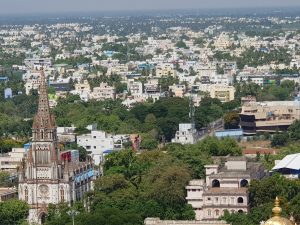
The Kapaleeshwarar Temple sits at the heart of Mylapore, one of the oldest residential quarters in Chennai. Dedicated to Shiva and his consort Karpagambal, this active place of worship carries forward centuries of living Shaiva traditions. Jasmine garlands, granite flagstones, and the deep sounds of the nadasvaram set a calm, devotional rhythm that welcomes travellers from the moment they step through the gateway.
If you are staying in Pondicherry and planning an excursion north, or heading toward Chennai for an onward flight, spending a few quiet hours here is well worth the journey. Here is a clear guide on what to see, how daily services work, and how to plan an easy visit.
At a glance
| Best time of day | Early morning at 6:00 am or late afternoon from 4:30 pm |
|---|---|
| Allow | 1 to 2 hours |
| Dress | Modest clothing covering shoulders and legs; traditional attire preferred |
| Photography | Allowed in outer courtyards; prohibited inside sanctums |
| From Pondicherry | roughly 150 km north, about 3 to 3.5 hours by road |
The history and sacred meaning of Mylapore
The name Kapaleeshwarar comes from two Sanskrit roots: kapala, meaning head or skull, and Ishvara, an epithet of Shiva. Regional Puranas tell that Brahma once failed to show Shiva due respect during a gathering on Mount Kailash. Shiva plucked off one of Brahma’s five heads in response. Seeking penance and wishing to regain his creative power, Brahma travelled down to Mylapore, installed a Shiva lingam, and worshipped here with devotion.
Another cherished story explains the origin of the neighbourhood. Parvati, having received a divine curse, came to this ground in the form of a peahen (mayil in Tamil) to do penance before Shiva. Having regained her divine form, she is venerated here as Karpagambal, the goddess of the wish-yielding tree. The surrounding settlement grew around her devotion and became known as Mayilai, which later became Mylapore.
Several revered Shaiva legends took place on this ground. Parvati gave her son Murugan the spear (vel) here to overcome a demon. The child-saint Sambandar is said to have brought Angam Poompavai back to life after she died from a snakebite, and the Nayanar saint Vayilar attained salvation on the premises. While 7th-century hymns by Sambandar and Appar suggest an older seaside shrine built by the Pallavas, the present complex was rebuilt inland around the 17th century, preserving inscriptions that date back to the 12th century.
What to see across the temple grounds
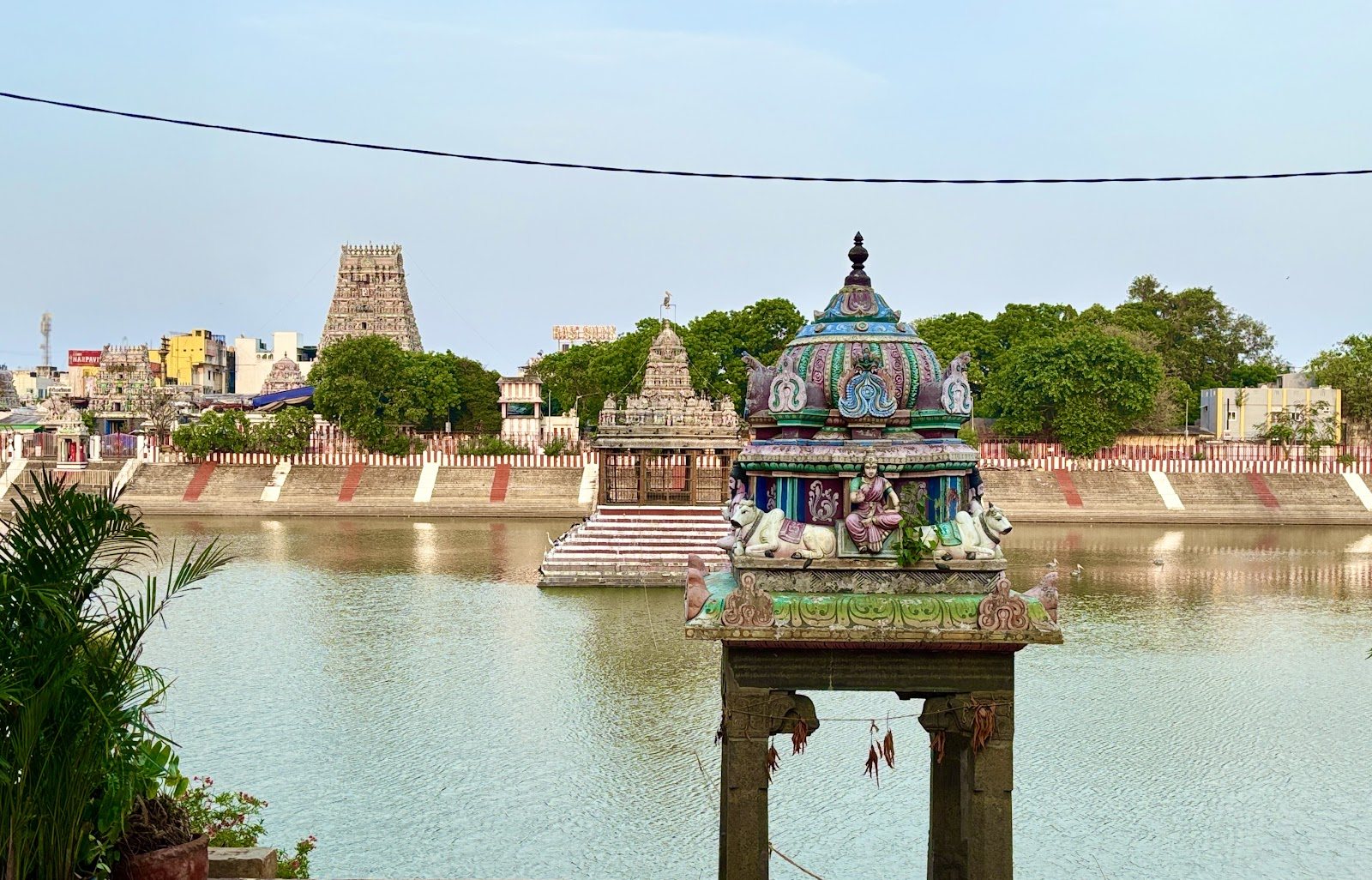
The temple is an enduring example of Dravidian architecture. Its main eastern gateway tower, the Rajagopuram, stands about 40 metres (around 120 feet) high. Built in 1906, it is adorned with tiers of stucco figures illustrating stories from Hindu scripture. A smaller gopuram opens on the western side, looking toward the wide temple tank.
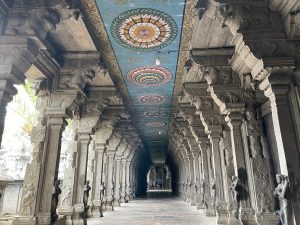
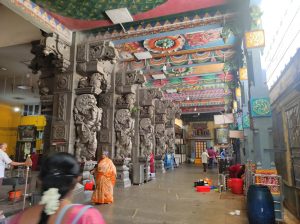
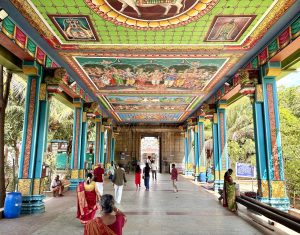
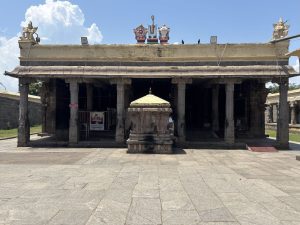
Once you pass the threshold, you will enter wide granite courtyards (prakarams) lined with carved stone mandapams. Key elements to look for include:
- The central sanctum of Kapaleeshwarar, where Shiva is worshipped in the form of a stone lingam.
- The shrine of Goddess Karpagambal, facing south and adorned with fresh silk and flower garlands.
- A small shrine beneath an ancient Punnai (Indian laurel) tree, showing Karpagambal in the form of a peahen worshipping the lingam.
- A pillared hall containing stone and bronze images of all sixty-three Nayanar saints.
- An enclosure housing a live peacock and peahen, recalling the founding story of Mylapore.
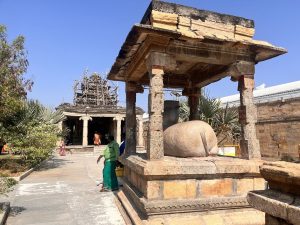
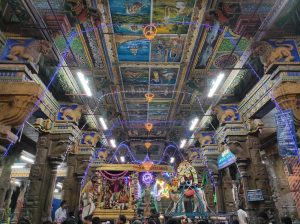
You will also notice the stored temple vehicles (vahanas) in the courtyards. These include an elephant, a bull (Adhikaranandi), a peacock, a goat, a bandicoot, and a parrot, along with a golden chariot brought out for processions.
How a visit works and rituals to observe
Kapaleeshwarar is an active communal sanctuary rather than a silent monument. Shaiva priests perform six daily rituals between the early morning and late night. Each ceremony involves four consistent steps: abhisheka (bathing the deity), alangaram (clothing and decoration), neivethanam (cooked food offerings), and deepa aradanai (the waving of lighted oil lamps).
| Ritual Name | Approximate Time | Significance |
|---|---|---|
| Ushathkalam | 6:00 am | Dawn worship and morning awakening |
| Kalasanthi | 9:00 am | Morning prayers and grain offerings |
| Uchikalam | 1:00 pm | Midday puja before afternoon closing |
| Sayarakshai | 5:00 pm | Evening lamp ceremony and music |
| Irandamkalam | 7:00 pm | Night worship with Vedic recitations |
| Ardha Jamam | 9:00 pm | Final night offering before sanctum closure |
During pujas, musicians play the nadasvaram and the tavil drum, while priests chant passages from the Vedas. Worshippers bow before the temple flagpole (dwajasthambam) and follow along quietly. In addition, Rahu Abhishekam takes place twice daily, at 11:30 am and 5:30 pm.
Local tip: If you attend on a Friday evening, you can see Karpagambal adorned with a kasu mala, an ornate garland composed of gold coins.
Etiquette, dress code, and temple rules
The complex is administered by the Hindu Religious and Charitable Endowments Department of Tamil Nadu. Observing local customs keeps the atmosphere harmonious for worshippers and visitors alike.
- Footwear: Remove your shoes before entering. Attended shoe stalls operate outside the eastern and western gates for a small coin fee.
- Clothing: Dress modestly. Men must wear trousers, dhotis, or pyjamas with shirts. Women should wear sarees, salwar kameez, or ankle-length skirts. Shorts, sleeveless tops, mini-skirts, and lungis are not permitted.
- Inner sanctum access: Non-Hindus can walk through the open courtyards, view the stone architecture, and observe outdoor rituals. Access into the inner sanctum sanctorum (garbhagriha) is traditionally restricted to practicing Hindus.
- Photography: Taking photos is forbidden inside all shrines and sanctums. You may photograph the outer gopurams from street level and open courtyard areas where signs permit.
- Decorum: Silence your mobile phones and speak in hushed tones inside the halls.
Best time to go and festival seasons
The temple doors generally open around 5:00 am, close in the early afternoon around 12:30 pm, and reopen from 4:00 pm to 9:00 pm. Arriving around 6:00 am gives you the calmest experience. The morning air is cool, the stone pavement has not absorbed midday heat, and the scent of camphor and fresh jasmine fills the walkways. Late afternoons around 5:00 pm are equally lovely, as the golden sunlight strikes the Rajagopuram and evening lamps are lit.
The major event on the calendar is the Panguni Brahmotsavam, held over ten days during the Tamil month of Panguni (mid-March to mid-April). The eighth day features the Arupathimoovar procession, where bronze figures of all sixty-three Nayanmar saints are carried through the neighbourhood streets. During the annual float festival (Theppam), deities are taken around the temple tank on an illuminated barge.
Getting there from Pondicherry and nearby stays
Kapaleeshwarar Temple is located on Ramakrishna Mutt Road in Mylapore, Chennai. If you travel from Pondicherry, the journey takes about 3 to 3.5 hours by car along the East Coast Road (ECR), covering roughly 150 km. Private taxis offer a comfortable point-to-point journey, while regular state buses travel from Pondicherry to Chennai bus terminals, where you can take a city cab or autorickshaw to Mylapore.
Within Chennai, Thirumayilai MRTS Railway Station is about 500 metres from the temple. Chennai Central station is roughly 8 km away, Chennai Egmore is about 6 km away, and Chennai International Airport is roughly 15 to 18 km southwest.
Travellers spending the night in Chennai can choose from city hotels in Mylapore, Alwarpet, or along Mount Road. If you are returning to Pondicherry to rest, coastal properties like Dune Eco Village Resort and Spa or Windflower Resorts and Spa offer a relaxing contrast to Chennai’s roads.
Exploring the Mylapore neighbourhood
After seeing the temple, take time to walk along North, South, East, and West Mada Streets, which surround the complex. These lanes feature flower stalls selling stringed tuberose, brassware shops offering traditional oil lamps, and small eateries serving South Indian filter coffee and dosas.
Directly to the west lies the Kapaleeshwarar Tank, also known as the Mylapore Tank. Measuring 190 metres long by 143 metres wide, this historic water body has a 16-pillared granite mandapam standing in its centre. A stone walkway borders the water, offering an open view of the western gopuram.
Other nearby heritage landmarks are easy to combine with your morning:
- The other Sapta Sthana Shiva temples of Mylapore, including Karaneeswarar, Tirttapaleeswarar, and Velleeswarar.
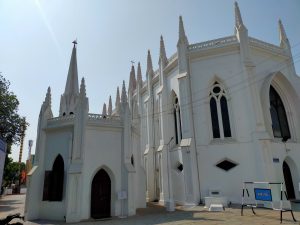
- San Thome Cathedral Basilica, located roughly 1 km east near the coastline.
- Sri Ramakrishna Math, a quiet universal temple and monastery situated about 1 km west.
- Luz Church (Our Lady of Light), one of Chennai’s oldest churches, located just north.
- Marina Beach, roughly 2 km away, ideal for an evening sea breeze.
What recent visitors say
A quick, honest snapshot from recent Google reviews, so you know what to expect before you go.
What people loved
★★★★★ A.D · in the last week
“Kapaleeshwarar Temple is one of the most beautiful and culturally rich places in Mylapore. The colourful gopuram covered with detailed sculptures immediately stands out, while the stone corridors and traditional Dravidian architecture give…”
★★★★★ Anoop · in the last week
“One of the Best temple in the world … Peaceful”
★★★★★ Sri · 2 months ago
“Kapaleeshwarar Temple is one of the most beautiful and spiritually significant temples in Chennai. The traditional Dravidian architecture, colourful gopuram, and divine atmosphere make this temple truly special. The moment you enter the…”
What some found difficult
★☆☆☆☆ Harin · in the last week
“Shivan would definitely punish these ppl if he is still here… Shocked to see the board that says “Non- Hindus” are not allowed in the deities residing place inside the temple premises… Christians never prohibited anyone, believe even…”
Reviews via Google Maps. Opinions are those of their authors.
Frequently asked questions
Are non-Hindus allowed to enter Kapaleeshwarar Temple?
Non-Hindus are permitted inside the gateway towers, outer courtyards, and pillared halls. However, entry into the inner sanctum sanctorum where the Shiva lingam resides is reserved for practicing Hindus.
What is the dress code for visitors?
Modest, conservative attire is required. Men should wear trousers, dhotis, or pyjamas with shirts, and women should wear sarees, salwar kameez, or long skirts. Shorts, sleeveless tops, and short skirts are strictly prohibited.
How far is the temple from Pondicherry?
Kapaleeshwarar Temple is roughly 150 km north of Pondicherry. The drive takes about 3 to 3.5 hours along the East Coast Road, depending on traffic conditions entering Chennai.
Is photography allowed inside the complex?
Photography is strictly forbidden within the shrines and inner sanctum areas. You may take pictures of the gopurams from street level and in permitted outer courtyard spaces.
What is the best time of day to visit?
Early mornings around 6:00 am provide a peaceful experience with cooler stone paving underfoot. Late afternoon around 5:00 pm is another great time to see the evening lighting of oil lamps.
Find it
Address: 234, Ramakrishna Mutt Rd, Vinayaka Nagar Colony, Mylapore, Chennai, Tamil Nadu 600004, India
You might also like
- Where to stay in Pondicherry
- Churches, temples, mosques and ashrams in Pondicherry
- Saneeswarar Temple
- Sri Aurobindo Ashram
- Sacred Heart of Jesus Church
- Things to do in Pondicherry
- Visiting Parthasarathy Temple in Triplicane Chennai
- Visiting Sri Parthasarathyswamy Temple in Chennai
- Visiting Santhome Cathedral Basilica in Chennai: A Guide
- Visiting Shri Ashtalakshmi Temple in Chennai: A Guide